How to Play Draw Dominoes — Rules, Strategy & Free Games
So you want to learn how to play draw dominoes? Good choice. Dominoes is one of those rare games that's been around for centuries yet still pulls people in — at kitchen tables, in parks, and now on browser screens worldwide. This guide covers everything: the core rules, how draw dominoes differs from block dominoes, strategy that actually works, and where to play free online right now without installing anything.
Whether you've never touched a domino tile or you're brushing up before a game night, this is the complete breakdown.
Domino Rules — How to Play Draw Dominoes
Draw dominoes is the most popular variant of the game, and it's what most people mean when they just say "dominoes." Here's how it works from the ground up.
The Set
A standard domino set has 28 tiles, each divided into two halves. Each half shows a number from 0 (blank) to 6. Every possible combination from double-blank to double-six appears exactly once. The numbers on each half are called pips.
Setting Up
Shuffle the tiles face-down. Each player draws their starting hand:
- 2 players: 7 tiles each
- 3–4 players: 5 tiles each
The remaining tiles stay in the middle as the boneyard — this is what separates draw dominoes from block dominoes, as you'll see below.
Starting the Game
The player with the highest double (double-six beats double-five, and so on) places it first. If no one has a double, the player with the highest overall tile goes first. That first tile sits in the middle of the table and becomes the starting point for the chain.
Playing Turns
On your turn, you place one tile from your hand onto either open end of the chain. The numbers must match — if the open end shows a 4, you can only attach a tile that has a 4 on one of its halves. The other half of your tile then becomes the new open end.
If you can't play, you draw from the boneyard one tile at a time until you either find something that fits or the boneyard runs out. This drawing mechanic is the defining feature of draw dominoes — you're never truly stuck as long as tiles remain.
Winning
A round ends when one player plays all their tiles (going out) or when the game is blocked — nobody can play and the boneyard is empty. If someone goes out, they score the total pips remaining in their opponents' hands. In a blocked game, the player with the fewest pips in hand wins and scores the difference between their total and each opponent's total. First player to reach 100 points (or another agreed target) wins the match.
Speaking of connecting pieces and earning points, this online game captures that exact satisfaction:
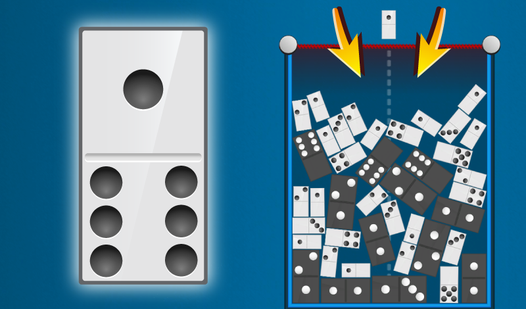
Merge dominoes. Get to thirteen!
Domino puzzles bring a unique satisfaction that keeps your brain sharp while rewarding every smart move you make. Merge dominoes. Get to thirteen! tra...
▶ Play FreeBlock Dominoes vs Draw Dominoes — Differences
Both games use the same tiles and the same matching rules, but the experience feels quite different once you understand what separates them.
The Boneyard Rule
This is the big one. In block dominoes, there is no drawing. Each player takes their starting hand, and that's it — no boneyard, no second chances. If you can't play on your turn, you simply pass. In draw dominoes, you keep drawing until you find a playable tile or run dry. This makes draw dominoes longer, more forgiving, and more suitable for beginners.
Game Length and Tension
Block dominoes tends to be faster and more cutthroat. Players who memorize tile distributions can calculate with precision whether an opponent is holding a key tile. Draw dominoes introduces uncertainty — someone might pull exactly what they need from the boneyard at the last moment. This randomness makes it feel more casual and social.
Strategy Differences
In block dominoes, holding tiles is almost always a losing strategy since you can't replenish. You want to play aggressively and control the open ends. In draw dominoes, holding a tile to create a specific board state can be viable, knowing your opponent might be forced to draw and weaken their hand. The presence of the boneyard changes every calculation.
Which Should You Learn First?
Draw dominoes. It's more forgiving, more common, and most online versions default to draw rules. Once you're comfortable with the basic flow, switching to block feels like a natural upgrade.
Want to take a creative break while you're learning? These browser art games are a great palette cleanser between domino sessions:
How to Play Draw Dominoes — Scoring Systems
Before jumping into strategy, it helps to understand the two main scoring systems you'll encounter online.
Simple Scoring (Go Out Wins)
The most common format: the player who empties their hand scores the sum of all pip values left in opponents' hands. Clean and easy to track.
Running Score
Some variants score after every round, adding up remaining pips. Some online games also award five points any time the open ends of the chain sum to a multiple of five — this is sometimes called "muggins" or "all fives." It adds a layer of mid-game tactics since you're trying to engineer specific totals on the board, not just get rid of tiles.
If you're playing casually, simple scoring is fine. If you want a more strategic experience, look for the all-fives variant — it rewards board control and careful tile management constantly, not just at the end of a round.
Draw the numbers with Russian voice
Kids who are eager to master counting will find Draw the numbers with Russian voice to be an incredibly engaging educational tool. This interactive ex...
▶ Play FreeBest Free Online Domino Games
You don't need to download anything to play dominoes online. Browser-based versions have gotten genuinely good over the past few years, with clean interfaces, fast matchmaking, and proper rule implementations.
What to Look For in a Browser Domino Game
- Clear pip visuals — tiles should be easy to read at a glance
- Accurate draw domino rules (boneyard present, unlimited drawing)
- Multiple difficulty levels for CPU opponents
- Score tracking across multiple rounds
- Mobile-friendly layout
Single Player vs Multiplayer
Most free online domino games offer both. Single-player CPU mode is perfect for learning the rules without pressure. Once you're confident, multiplayer modes add the psychological dimension — reading when opponents are drawing heavily, timing your blocking moves, managing end-game tiles.
Speed Variants
Some online platforms offer timed turns, which changes the game significantly. You can't overthink positions when you have 15 seconds. This is actually a great way to build faster pattern recognition for tile matching.
Here are some other free browser games worth trying while you're in gaming mode:

Draw fruits!
Transform blank canvases into vibrant pixel art masterpieces by carefully filling in every section of your favorite treats. You control the brush to b...
▶ Play Free
Draw Nubik 2!
Fans of the popular noob adventures will absolutely fall in love with the creative challenges found in Draw Nubik 2. This addictive drawing game invit...
▶ Play Free
Pixel Draw
Creative artists and retro gaming fans will love the freedom found in Pixel Draw. This browser-based canvas turns your screen into a digital playgroun...
▶ Play FreeStrategy Tips for Winning at Dominoes
Once you know how to play draw dominoes, strategy is what separates consistent winners from lucky ones. These tips apply to both online and offline play.
1. Track Tiles That Have Appeared
A standard set has 28 tiles. Every tile you see played — including your own — is information. If both 6-blank tiles are on the table, you know no one is holding a 6-blank. This matters when you're deciding whether to play to a 6 end or leave it open. Experienced players mentally track tile frequency, focusing on the numbers they have lots of or are trying to block.
2. Control the Open Ends
The two open ends of the chain are your battleground. Playing a tile that creates an end you have multiples of means you'll have more options on future turns. If you hold four tiles with a 3 on them, playing to keep a 3 end open gives you maximum flexibility. Conversely, playing to an end you can't follow up on is a risky move unless you're deliberately trying to trap an opponent.
3. Force Opponents to Draw
When you suspect an opponent can't match a particular number — because you hold several of those tiles yourself — play aggressively to that number. Every tile they draw from the boneyard increases their pip count. Even if they find a match, they've loaded up their hand, which hurts them if the round ends.
4. Manage Your High-Pip Tiles Early
Tiles like 6-5, 6-4, and 5-4 carry heavy pip penalties if they're still in your hand when someone else goes out. Don't hoard them hoping for the perfect moment. Play high-pip tiles whenever you have a reasonable opportunity, even if a lower tile would be slightly more strategic. The penalty for getting caught with double-six is severe.
5. Double Tiles Are Pivotal
Doubles (both halves show the same number) are special because they only play on one type of end. If you're holding double-three, you need a 3 end to appear on the board before you can play it. Doubles can clog your hand fast. Play them early when you can, or use them to block opponents if you know they need that number.
6. The Endgame — Count Down
In the final stages of a round, try to count how many tiles each opponent likely holds and estimate what numbers they might have based on what's been played. If someone hasn't played a 5 all game and the board shows no 5-ends, they might be sitting on several 5s. Keeping 5-ends open costs them. This kind of deductive play is what makes dominoes genuinely deep despite its simple surface rules.
Draw Noob!
Sketch your way to victory by tracing complex pixel art designs to help your blocky friend overcome every challenge. Draw Noob! offers a creative take...
▶ Play Free
Draw a Pony: ASMR coloring book
Trace delicate outlines to bring each pony to life through a relaxing digital art experience. You start by connecting dots to form the perfect silhoue...
▶ Play FreeCommon Mistakes Beginners Make
Knowing what not to do is just as useful as knowing the right moves.
Playing Too Defensively
New players often hold onto tiles waiting for the perfect play. In draw dominoes this is less punishing than in block, but it still hurts. Every tile you don't play is a tile you might be stuck with. Play proactively.
Ignoring the Boneyard Count
If the boneyard is nearly empty, the game is close to a blocked state. Your strategy needs to shift — you can't rely on drawing your way out of a jam. Assess what you're holding and start making exit plays.
Forgetting About Doubles
Doubles are the most inflexible tiles in your hand. Treat them as urgent. A double-six sitting in your hand at round end is a 12-point gift to your opponent.
Not Paying Attention to Other Players' Drawing
When someone draws two, three, four times in a row, they're telling you something. They don't have the number that's on the end. That's valuable intel — play to that end again.
Trying to Win Every Round
Sometimes the smart play is managing your pip count so that even if you don't go out first, you lose fewer points. Reducing your hand's total value is always useful, especially in a long match.
Domino Variants Worth Knowing
Once you've mastered draw dominoes, these variations are a natural next step.
Chicken Foot
Players must connect to a "chicken foot" formation at the start, branching the chain into multiple directions. More visual, more chaos, great for large groups.
Mexican Train
Each player builds their own "train" of tiles extending from a central hub. You can also play on a shared "Mexican train" anyone can add to. One of the most popular party variants.
Matador
Instead of matching pips exactly, players play tiles that sum to seven (or play a matador, which is a wildcard). Completely changes the strategy calculus.
All Fives (Muggins)
Scoring happens in real-time whenever open ends sum to a multiple of five. Creates constant tactical decisions throughout the game, not just at round end.
All of these share the same tile set and the same physical matching intuition you build playing draw dominoes. Learning the base game first means every variant clicks faster.
Draw Bridge: Puzzle Challenge
Sketch a sturdy path across treacherous gaps to help your daredevil hero conquer every level in Draw Bridge: Puzzle Challenge. This addictive logic ga...
▶ Play FreePlaying Dominoes Online — What to Expect
The online experience has a few quirks worth knowing before your first session.
Automated Rule Enforcement
Online games handle all the rule checking for you — valid plays are highlighted, invalid ones are blocked, and scoring is calculated automatically. This is great for learning because you never accidentally make an illegal move.
Undo Buttons
Some platforms allow undoing a move if your opponent agrees. In competitive settings this isn't available. Don't rely on it.
Disconnections
In multiplayer games, a player disconnecting usually results in a CPU taking over their position or the game counting as a forfeit. Check platform rules before long sessions.
Chat and Emotes
Many domino platforms include basic chat or reaction emotes. These are part of the social fabric of online play — using them makes games feel less mechanical.
Practice Mode
Almost every decent platform has a solo practice or tutorial mode. Use it. Even experienced players benefit from a few practice rounds when trying a new scoring variant or interface.