What Are Strategy Games: Guide for Beginners
Strategy games have been captivating players for decades, and if you've ever asked yourself "что такое Strategy игры" — what exactly this genre is about and whether it's right for you — you're in the right place. This guide covers everything: the history of the genre, the main subgenres, tips for getting started, and the best free strategy games you can play right now in your browser.
Что такое Strategy игры — and Why Everyone Should Try Them
At their core, strategy games are about making decisions. Not reflex decisions — thinking decisions. You win not by clicking faster than your opponent but by planning ahead, managing resources wisely, and outmaneuvering whatever the game throws at you.
That fundamental shift — brain over fingers — is what makes strategy games special. They respect your intelligence. Every failure is a lesson. Every victory feels earned. When your plan clicks into place after five minutes of careful setup, that satisfaction is hard to match in any other genre.
Strategy games span an enormous range. On one end, you have a quiet logic puzzle on your lunch break. On the other, a sprawling war simulation involving dozens of decisions per minute. What unites them is simple: thinking beats clicking.
The good news for newcomers is that "что такое Strategy игры" has never been easier to answer by just playing — browser-based strategy games mean you can jump in for free, right now, no downloads required.
One of the best entry points is a game that reframes strategy entirely: instead of commanding armies, you're building chain reactions.

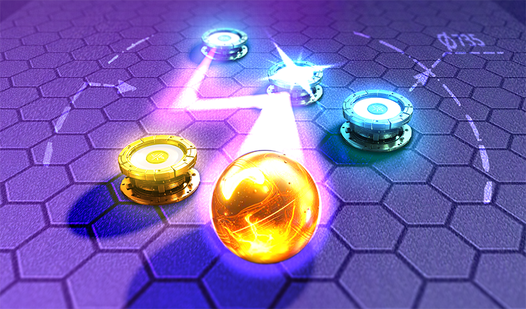
Strategy of Luck
Strategy of Luck turns the classic mechanics of physics-based ball games into a complex puzzle constructor where your tactical planning determines the...
▶ Play FreeA Brief History of the Genre
Strategy gaming didn't start with computers. It started with boards.
Chess, developed around the 6th century in India, is arguably humanity's first strategy game. Go, an ancient Chinese game with deceptively simple rules, has been played for over 2,500 years. Checkers, backgammon, shogi — humans have always been drawn to games where thinking ahead beats everything else. These games proved something important: the mental challenge of outmaneuvering an opponent is one of the purest pleasures we know.
When personal computers arrived in the late 1970s and 1980s, the genre found a new home. Early titles on the Apple II and Commodore 64 adapted board-game concepts to digital form. Then came the game that changed everything: Civilization (1991). Sid Meier's masterpiece introduced millions to the idea of building an empire from a single settler to a space-faring civilization. It was addictive, deep, and proved that strategy games could be mainstream.
Real-time strategy emerged shortly after. Dune II (1992) established the template that would define the genre for a decade: build a base, gather resources, train an army, destroy your opponent. Warcraft, StarCraft, and Age of Empires refined this formula into something millions of players worldwide still love.
The 2000s brought strategy games to mobile devices, and with them, new subgenres. Tower defense games exploded in popularity. Puzzle-strategy hybrids attracted players who'd never touched a traditional strategy game. Today, the genre is broader and more accessible than ever — and a huge portion of it lives in your browser.
Checkers might be ancient, but it's still one of the cleanest introductions to strategic thinking you can find:
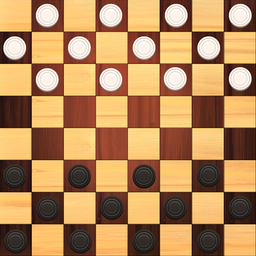
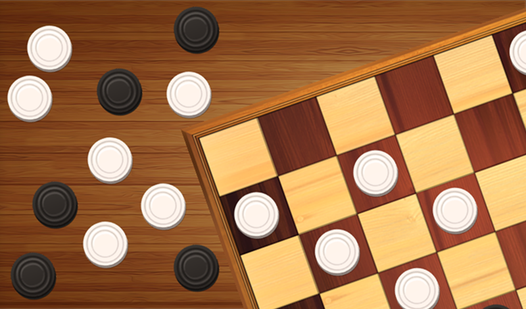
Checkers: a winning strategy
Staring at a blank screen during your coffee break is a recipe for boredom when you could be sharpening your mind instead. Checkers: a winning strateg...
▶ Play FreePopular Subgenres of Strategy Games
The strategy genre is enormous. Here are the main flavors you'll encounter as a newcomer:
Real-Time Strategy (RTS)
You and your opponent act simultaneously. Build your base, gather resources, produce units, and fight — all at once. The pressure never lets up, and efficiency matters as much as planning. Great RTS players think about the next five minutes while executing the current thirty seconds. Demanding, but incredibly satisfying once it clicks.
Turn-Based Strategy (TBS)
You make your moves, then the opponent makes theirs. This format strips away time pressure and rewards pure strategic thinking. Chess is the platonic ideal. Turn-based games tend to be the most accessible entry point because you're never rushed — you can take as long as you need on each decision.
Tower Defense
Your job: stop waves of enemies from reaching a goal by placing defensive structures at key chokepoints. Simple to grasp, endlessly deep to master. The challenge lies in making tough calls — do you invest in upgrades now or save resources for later? Tower defense trains resource management and positional thinking in the most intuitive way possible.
Puzzle Strategy
Logic puzzles with strategic depth. You might need to find an optimal sequence, route connections, or figure out how to clear a board efficiently. Puzzle-strategy games are often the gentlest on-ramp for newcomers — they teach core strategic concepts (forward planning, resource efficiency, positional thinking) without overwhelming complexity.
Merge Strategy
A modern subgenre where you combine weaker units into stronger ones while managing a battlefield or ecosystem. Satisfying in short bursts and surprisingly deep. Merge games have become one of the most popular casual strategy formats because they're immediately intuitive but reward deeper play.
War Strategy
Command armies, capture territory, manage logistics. War strategy games range from arcade-simple skirmishes to complex simulations that model supply lines and morale. For newcomers, smaller-scale war games — defend a position, route an attacking force — offer a great taste of the genre without the overwhelming scope of full-scale wargames.
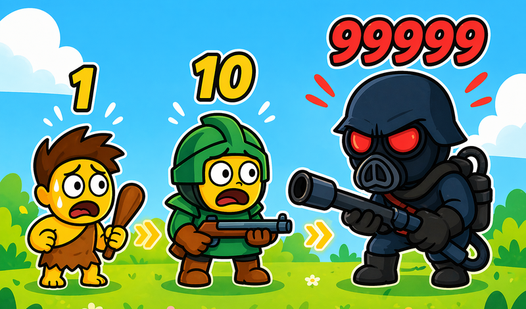
Noob vs Pro RobCraft delivers the army-management experience in an accessible, personality-filled package:
Best Strategy Games for Beginners
Here are the best strategy games on FreeJoy for players new to the genre — all free, all playable right in your browser.
Block Puzzle: Mastery Strategy
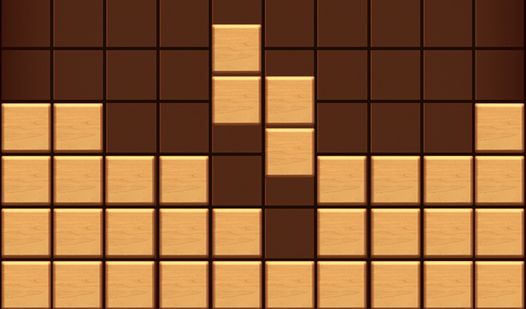
Don't let "puzzle" make you underestimate this one. Block Puzzle: Mastery Strategy is a genuine strategic workout disguised as a casual game. You place tetromino-style pieces on a grid, but every placement matters because poor early decisions can leave you with no valid moves later. This game trains exactly the kind of long-range thinking that all strategy games reward — you're not just solving the current moment, you're setting up the board three steps ahead.
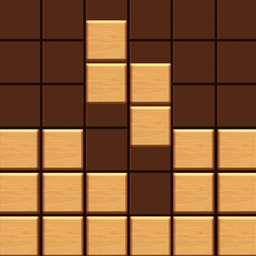
Block Puzzle: Mastery Strategy
Strategic thinkers and arcade enthusiasts will fall in love with the fast-paced intensity of Block Puzzle: Mastery Strategy. This modern twist on the ...
▶ Play FreeNoob's War and Strategy against Zombies
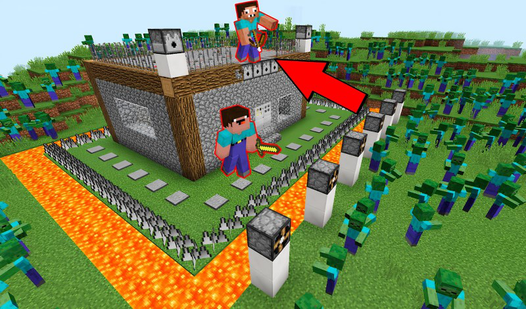
Ready to command an army? Noob's War and Strategy against Zombies puts you in charge of forces fighting back waves of undead. You manage troops, position them wisely, and adapt as enemies escalate. It's a great introduction to tactical resource management — knowing when to push, when to hold back, and how to spend your resources most efficiently. The zombie setting keeps things approachable while the strategy underneath is genuinely meaty.
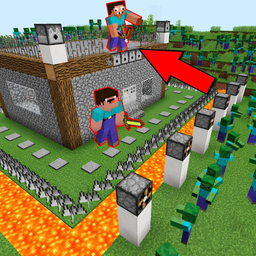
Noob's War and Strategy against Zombies
Surviving against relentless waves of undead requires more than just raw power because holding the line demands true tactical genius. Noob's War and S...
▶ Play FreeGrowing Numbers: Connect and Purify
Math meets strategy in this clean, satisfying number-connection game. You link matching numbers to clear the board, but optimal routing becomes increasingly challenging as levels progress. It's the kind of game that looks simple until you realize how many moves ahead you need to think to avoid painting yourself into a corner. Perfect for anyone who appreciates their strategy cerebral and uncluttered.
Growing numbers: Connect and Purify
Fans of brain-teasing challenges will find Growing numbers: Connect and Purify the perfect way to sharpen their mental skills. This addictive puzzle t...
▶ Play Free2048 Merge Blocks
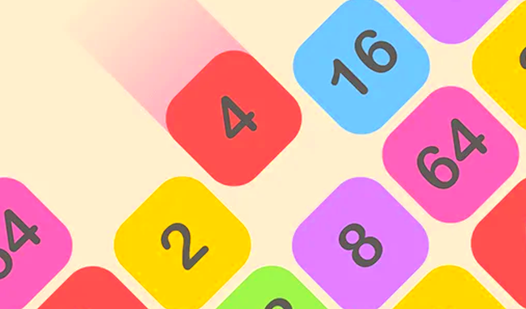
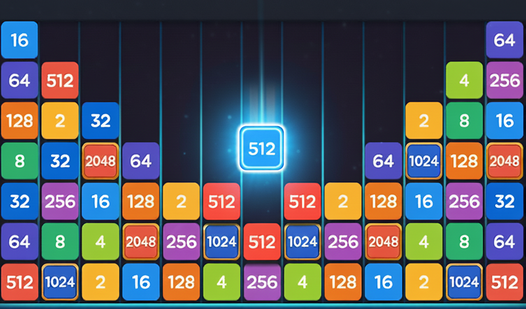
The 2048 formula — slide tiles, merge matching numbers, push toward higher and higher values — is one of the most elegant strategy puzzles ever designed. Every single slide has consequences. A bad move in the first minute can close off your options an hour later. It's immediately playable, impossible to fully master, and genuinely addictive. If you want a pure taste of strategic decision-making with no fluff, this is the game.
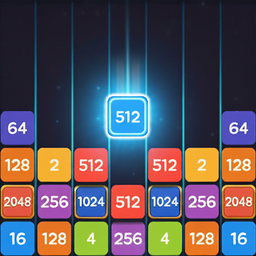
2048 Merge Blocks
Staring at a stagnant screen while waiting for your next meeting or commute can feel like an eternity. 2048 Merge Blocks provides the perfect mental e...
▶ Play FreeConnect Pipes: Pipeline
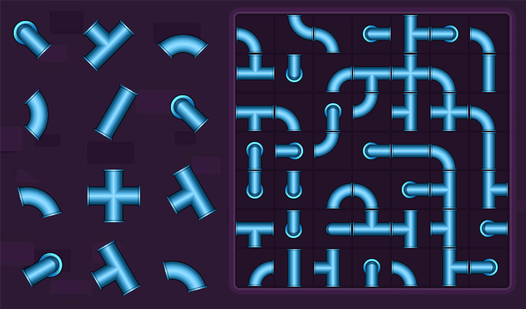
Connect Pipes asks a simple question: can you route all the pipes so every connection flows? Straightforward at first, increasingly tricky as layouts grow more complex. This game teaches efficiency and spatial planning — two skills that transfer directly to more complex strategy games. Great for anyone who likes their challenges clean and logical.

Connect Pipes: Pipeline
Rotate scattered pipe segments across the grid to build a seamless flow from the starting source to the finish line. Every move counts as you refine y...
▶ Play FreeFunny Regiments
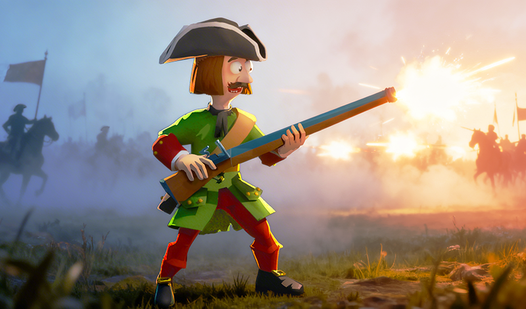
Want unit deployment with personality? Funny Regiments wraps solid tactical gameplay in a colorful, lighthearted package. You position forces, respond to enemy movements, and figure out the optimal way to clear each wave. The visual style is cheerful but the strategy asks real questions: where should your strongest units go? How do you handle multiple attack vectors at once?
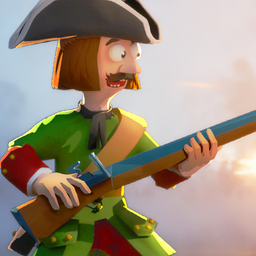
Funny Regiments
Warfare in the 18th century was rarely this hilarious, blending high-stakes musket combat with absolute battlefield chaos. Funny Regiments drops you i...
▶ Play FreeArmy Evolution: Merge & Tactics
This game combines two beloved mechanics: merging units into stronger versions and deploying them in real-time tactical combat. Managing the merge economy while keeping your front line from collapsing requires genuine multitasking of the strategic kind. If you enjoy the merge format but want more tactical depth than a pure puzzle offers, Army Evolution delivers exactly that.
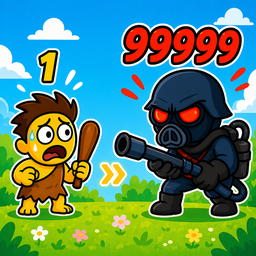
Army Evolution: Merge & Tactics
History comes alive on the battlefield as you command forces ranging from ancient knights to high-tech robots in Army Evolution: Merge & Tactics. Mast...
▶ Play FreeJurassic Battle! Dinosaur Evolution!
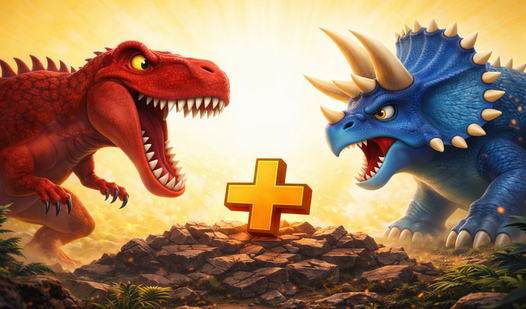
Who said strategy games need to be serious? Jurassic Battle brings evolution and prehistoric combat together in a way that's immediately engaging. You evolve creatures, combine them into more powerful forms, and lead them into battle. The setting is fresh, the mechanics are fun, and the evolutionary strategy adds a layer of long-term thinking that keeps the game interesting well beyond the first few sessions.
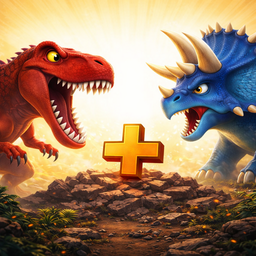
Jurassic Battle! Dinosaur Evolution!
Merge identical creatures to forge an unstoppable prehistoric army and dominate the arena in Jurassic Battle! Dinosaur Evolution! Every successful fus...
▶ Play FreeЧто такое Strategy игры — The Mental Skills You'll Build
One of the most underappreciated things about strategy gaming is what it does for your thinking outside of games. Strategy игры для новичков aren't just entertainment — they're surprisingly good training for real-world decision-making.
Forward planning. Every experienced strategy player learns to evaluate actions not by their immediate result but by how they set up the next five moves. This habit of thinking ahead transfers to work, finances, and any domain where the present is shaped by what comes later.
Resource management. Almost every strategy game involves finite resources — time, currency, units, moves. Deciding how to allocate them optimally under pressure is a skill that gets better with practice.
Adaptability. Plans rarely survive contact with the enemy. Good strategy players learn to hold plans loosely — commit to a direction but adapt quickly when circumstances change. Rigid thinkers lose. Flexible thinkers win.
Pattern recognition. Over time, you start seeing common situations — and you remember how those situations resolved last time. This pattern library builds faster than most people expect, and it's one of the main reasons experienced players improve faster than newcomers expect.
Risk assessment. Strategy games constantly present bets: do I attack now with 60% confidence, or wait until I'm at 90%? Learning to calibrate these decisions — knowing when a calculated risk is worth taking and when caution pays off — is a skill that applies far beyond gaming.
Strategy игры Онлайн: Why Browser Games Are Perfect for Beginners
A decade ago, getting into strategy gaming required patience: install a client, download patches, sit through tutorials. The barrier to entry was real.
Browser-based strategy игры онлайн (online strategy games) have changed all of that. On FreeJoy, every game loads instantly. You can try something, decide it's not clicking for you, and switch to something else in thirty seconds. That freedom to experiment is invaluable when you're still figuring out what kind of strategy gaming actually appeals to you.
There's also the zero-cost factor. Every game on FreeJoy is free. You can build your skills, explore different subgenres, and find what you genuinely love — all before spending a single coin. That's the ideal way to approach any new gaming genre: sample widely, find your preference, commit to what resonates.
Practical Tips for New Strategy Players
A few principles that speed up the learning curve significantly:
Start with what interests you. If you love puzzles, begin with puzzle-strategy games. If you want action, start with war-strategy titles. The best strategy game for a beginner is the one they actually want to play.
Lose on purpose sometimes. Deliberately try an approach you expect to fail — just to see why it fails. Intentional experimentation teaches faster than cautious play.
Don't overextend. A classic beginner mistake: expanding too fast before consolidating what you already have. In most strategy games, stable beats fast.
Pay attention to what beats you. If you lose to the same tactic repeatedly, study it. Understanding why something is effective is the first step to countering it.
Play in short sessions consistently. Even 15 minutes daily builds pattern recognition faster than occasional long sessions. Regularity beats marathon play.
Read the win condition, not just the rules. Most beginners learn the mechanics but don't deeply understand the goal. Know exactly what you're optimizing for — then reverse-engineer everything from there.