How to Play 15 Puzzle: Rules, Tips & Strategies
If you've ever stared at a grid of scrambled tiles wondering how to play 15 Puzzle without losing your mind — you're in the right place. The 15 puzzle is one of the oldest and most beloved brain teasers ever created, and it's just as satisfying today as it was when Sam Loyd popularized it back in the 1870s. Whether you're a complete beginner or someone who wants to shave seconds off their solve time, this guide covers everything: the rules, a step-by-step solving method, speed-solving tricks, and the best 15 puzzle games online free to try right now.
What Is the 15 Puzzle (Sliding Puzzle)
The 15 puzzle is a classic sliding tile puzzle played on a 4×4 grid containing 15 numbered tiles and one empty space. The goal is simple: starting from a scrambled state, slide the tiles around using the empty slot until all numbers are arranged in order from 1 to 15, left to right, top to bottom — with the empty space in the bottom-right corner.
That's the whole game. No timer pressure (unless you add one), no opponents, no special mechanics. Just you, 15 tiles, and a blank square.
Why is it so hard?
The puzzle looks deceptively simple, but the math is brutal. A 4×4 grid has over 10 trillion possible configurations — and exactly half of them are unsolvable. Yes, half. If you start from a randomly scrambled board, there's a 50% chance it literally cannot be solved. This is a mathematical property discovered in the 19th century: only even permutations of the tiles are reachable from the solved state.
So if you've ever been grinding away at what felt like an impossible configuration — it might actually have been impossible. Online versions typically generate only solvable states, so that specific frustration is taken care of for you.
The basic controls are dead simple. Click (or tap) any tile adjacent to the empty space, and it slides into that space. You can't jump tiles, you can't rotate, you can only slide. That single constraint is what makes the puzzle so elegantly challenging.
The 15 puzzle belongs to a broader family of sliding puzzles — 8-puzzle (3×3), 24-puzzle (5×5), picture sliding puzzles, and more. The logic transfers across all of them, so mastering the 15 is a great foundation.
Block puzzle games share a similar DNA — you're manipulating shapes within a constrained grid, planning moves ahead, and satisfying that deep-brain craving for order. Block Puzzle Gem brings that same relaxing yet engaging challenge to a gem-themed format, making it a perfect warm-up for tile-based thinking.
Block Puzzle Gem
Ever wondered what makes classic puzzle games so endlessly engaging? Block Puzzle Gem takes that timeless appeal and polishes it to a brilliant shine,...
▶ Play FreeHow to Solve the 15 Puzzle Step by Step
Learning how to do 15 puzzle systematically is the key to not going crazy. Random sliding gets you nowhere fast. The standard beginner approach is to solve the puzzle row by row, starting from the top.
Phase 1: Solve the Top Row (Tiles 1–4)
Your first goal is to get tiles 1, 2, 3, and 4 into their correct positions in the top row. Work on tile 1 first, then 2, then 3 and 4 together.
Solving tiles 1 and 2 individually is pretty intuitive once you understand the basic move sequences. The trick is learning to move a tile to a target position without disturbing tiles you've already placed. You'll develop a feel for routing tiles around the board.
Tiles 3 and 4 together require a specific technique because placing tile 3 directly often knocks tile 4 out of position. The standard method:
- Position tile 3 directly above its target spot (in column 3, row 2)
- Position tile 4 to the right of its target spot (in column 4, row 1)
- Execute a rotation sequence: move tile 4 left into position, then bring tile 3 down — this typically uses a 5-move cycle
Phase 2: Solve the Second Row (Tiles 5–8)
Once the top row is locked in, you can ignore it entirely and work on the second row using the same approach. Treat the remaining 3×4 sub-grid as your new puzzle. Same logic: tiles 5 and 6 individually, tiles 7 and 8 together with the rotation trick.
The golden rule: never disturb completed rows. Every move you make in the lower part of the board should be designed to avoid sliding anything back into the top rows. This becomes second nature after a few dozen solves.
Phase 3: Solve the Left Column of the Remaining 2×4 Grid
Now you have a 2-row, 4-column grid left (tiles 9–15 plus the blank). Switch strategy here: instead of working row by row, solve the left column (tiles 9 and 13) together first, using the same vertical rotation trick you used for tiles 3/4 and 7/8 — just rotated 90 degrees.
Phase 4: Solve the Remaining 2×3 Grid
You're now down to a 2×3 patch with 5 tiles and one blank. From here, the puzzle typically resolves with a series of cycling moves. There are a handful of known 2×3 configurations and their solutions — learning these patterns by heart is what separates casual solvers from fast ones.
Spatial reasoning under constraints is a skill that transfers to other puzzle formats too. Block Puzzle: Block Builder pushes exactly this — fitting falling shapes into a limited grid, demanding that you think ahead about where pieces will land. If the 15 puzzle trains your analytical side, Block Builder trains your reactive side.
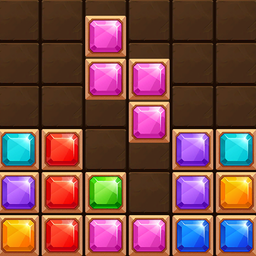
Block Puzzle: Block Builder
Puzzle lovers and fans of classic brain teasers will find Block Puzzle: Block Builder an incredibly addictive experience. This isn't just another bloc...
▶ Play FreeA Note on Move Count
Solving methodically is more important than solving efficiently at first. As you practice, you'll naturally start optimizing your paths — taking 3 moves instead of 7 to reposition a tile. Beginners typically solve in 200–400 moves; experienced solvers get it done in under 100, and world-class speedsolvers finish in 50–60 moves.
Advanced Strategies and Speed-Solving Tips
Once you've internalized the row-by-row method, the question becomes: how do you get faster and more efficient? Here are the real 15 puzzle tips that make a difference.
1. Learn Your Move Sequences Cold
There are about a dozen fundamental move sequences (sometimes called "macros" or "algorithms" in speedsolving communities) that handle every situation you'll encounter. The 3-cycle, the 5-move insertion, the L-rotation — once these are muscle memory, you stop thinking about individual moves and start thinking about tile placement at a higher level.
2. Plan Multiple Moves Ahead
Beginners react to the current board state. Intermediate players look 3–5 moves ahead. Advanced solvers are planning entire phase transitions in their head before moving a single tile. Train this by pausing before each move and asking: "Where will this tile end up, and what does that open up or close off?"
3. Reduce "Wasted" Moves
Every time you move the blank to a new position just to set up a real move, that's overhead. Try to route the blank efficiently. Think of the blank space as a tool you're maneuvering, not just an empty slot that happens to move when tiles slide into it.
4. Use the "Opposite Corner" Trick for Final 2×2
The last four tiles (12, 13, 14, 15 in the final 2×2) often get stuck in a rotation. There's a well-known 8-move cycle that rotates three tiles in a 2×2 without disrupting the rest of the board. Learning this cycle cold will save you enormous frustration in endgame.
5. Recognize Parity Early
When you get to the last row or the final 2×3 patch, sometimes two tiles are swapped and everything else looks right. This is a parity issue — and it means you made an error somewhere earlier. Don't try to "fix" it in the endgame; instead, recognize the pattern and go back up one phase to correct your placement.
Sometimes the best puzzle challenge is one with a visual, relaxing component. Relax Jigsaw Puzzles delivers exactly that — a full jigsaw experience with adjustable difficulty, letting your spatial reasoning brain cool down between intense sliding sessions.

Relax Jigsaw Puzzles
Feeling a little stressed out or just need a satisfying break from your daily grind? Relax Jigsaw Puzzles is here to whisk you away into a world of ca...
▶ Play Free6. Time Yourself
Nothing improves your solving speed like a clock running. Set a personal best, then try to beat it. Even 5 minutes of timed solving practice per day produces noticeable improvement within a week.
7. Shadow-Solve
Watch recorded fast solves (there are many on YouTube) and try to follow along with your own puzzle. Notice which tiles they prioritize, how they route the blank, and when they switch from individual tile placement to batch strategies.
8. Understand the Solvability Check
Knowing whether a given scramble is solvable before you start is a useful skill. The formula: count the number of inversions (pairs of tiles where the higher number appears before the lower number when read left-to-right, top-to-bottom), then add the row number of the blank space (counting from the bottom). If this sum is even, the puzzle is solvable.
This is more useful for puzzle creators and developers than casual players, but knowing it deepens your understanding of the underlying structure.
For players who love that "one more round" pull of score-based puzzles, Block Puzzle: Falling Shapes provides it in spades — a time-pressured falling-block challenge where maximizing points requires the same kind of rapid spatial calculation that speed-solving a 15 puzzle demands.
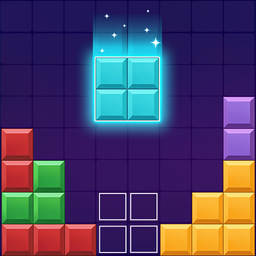
Block Puzzle: Falling shapes
Falling blocks carry a unique thrill that has defined classic gaming for generations. Block Puzzle: Falling shapes takes this timeless concept and ref...
▶ Play FreeBest Free 15 Puzzle Games Online
The 15 puzzle in its pure form is freely available all over the web — but what if you want something adjacent, something that scratches the same itch with fresh mechanics? Here are the best 15 puzzle games online free (and puzzle games with similar logic) you can play right now on FreeJoy.
2048 Numerical Puzzle: The Square of Numbers is the closest cousin to the 15 puzzle in terms of pure number-grid logic. Instead of rearranging tiles to fixed positions, you're merging them — but the underlying skill of anticipating chain reactions and managing a constrained grid is exactly the same muscle. It's simple, addictive, and deeply satisfying when the 2048 tile finally appears.
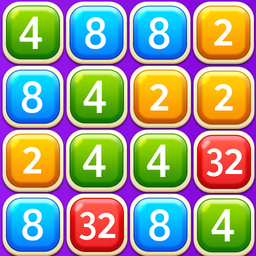
2048 Numerical Puzzle: The Square of Numbers
Staring at a blank screen during a lunch break often feels like a missed opportunity for some serious mental stimulation. 2048 Numerical Puzzle: The S...
▶ Play FreeThe puzzle genre is enormous, and the spatial reasoning skills you build with the 15 puzzle carry across many formats. Here are more great puzzle games to explore:
Bubble Shooter: Bubble Puzzle Game
Need a quick mental escape from the daily grind? Bubble Shooter: Bubble Puzzle Game is your go-to for instant fun and satisfying puzzle-solving. This ...
▶ Play Free
Cute Tiles: Puzzle
Feeling a bit bored and need a quick mental break? Cute Tiles: Puzzle is your cozy escape into a world of satisfying tile-matching and aesthetic charm...
▶ Play Free
Sudoku: Classic Puzzles
Place numbers from one to nine into the grid making sure every row and column holds each digit only once. Mastering Sudoku: Classic Puzzles requires s...
▶ Play Free
Color Puzzle: Create a Palette
Arrange vibrant squares into perfect gradients to complete your masterpiece in Color Puzzle: Create a Palette. This relaxing color puzzle experience c...
▶ Play Free
Merge Planets: Suika puzzle
Space enthusiasts and fans of addictive brain teasers will find themselves hooked on Merge Planets: Suika puzzle from the very first drop. This celest...
▶ Play FreeWhat to Look for in a Good Online 15 Puzzle
Not all online implementations are equal. Here's what separates a great version from a frustrating one:
Solvability guarantee. A good puzzle generator always produces solvable boards. Sounds obvious, but some poorly-coded versions can generate impossible states. Look for implementations that explicitly note solvability checking.
Move counter and timer. These two metrics together give you everything you need to track improvement. Move count tells you efficiency; time tells you raw speed.
Shuffle strength. Some versions do a weak shuffle that results in nearly-solved boards. A proper implementation does a full random shuffle (from the space of solvable permutations). The solve should feel like genuine work.
Undo button. Useful when learning. More advanced players turn this off as a self-imposed challenge.
Custom images. Picture sliding puzzles (where the tiles form an image when solved) add a visual layer of satisfaction. These are great for players who find pure-number puzzles abstract.
Mobile-friendly controls. Sliding tiles should feel natural on touch screens — swipe to slide, not just tap.