How to Play Spider Solitaire with 2 Decks
Spider Solitaire is one of the most rewarding card games around, and knowing how to play Spider Solitaire with 2 decks puts you right at the sweet spot of challenge. The 2-suit variant is harder than the beginner-friendly 1-suit version but more manageable than the brutal 4-suit game. It rewards patience, planning, and a healthy respect for suit organization.
This guide covers the complete rules, how to set up the table, strategies that actually move the needle, and the traps that catch most players off guard. You'll also find the best free Spider Solitaire games to practice on — no download, no install, just play.
Spider Solitaire 2-deck rules explained
Spider Solitaire always uses two standard 52-card decks — 104 cards total — regardless of which variant you're playing. The difference between 1-suit, 2-suit, and 4-suit versions comes down to how many suits appear in the game.
In the 2-suit variant:
- Only hearts and spades are active
- Both decks contribute cards, giving you 4 copies of each card value per suit (e.g., four 7-of-spades, four Ace-of-hearts)
- The goal is to build 8 complete sequences, King down to Ace, all in the same suit
The objective
You win by assembling 8 complete 13-card runs — King, Queen, Jack, 10, 9, 8, 7, 6, 5, 4, 3, 2, Ace — all in the same suit. Each completed sequence is removed from the table automatically and counted as a foundation pile. Build all 8, and you win.
Card movement rules
This is where most confusion happens, and getting it right is essential.
Any card can be placed on any card that is one rank higher — regardless of suit. A 7 of hearts can legally sit on an 8 of spades. No problem there.
The catch: only a fully same-suit sequence can be moved as a group. If you have a run of 8-of-spades, 7-of-hearts, 6-of-hearts, that's a mixed sequence. You cannot pick it up and move it. You can only move the top card (6-of-hearts) individually.
This rule is what gives 2-suit Spider its texture. You're constantly balancing two competing goals: stacking cards quickly (using any-suit placement for speed) while keeping suits clean enough that you can actually move groups when needed. Messy mixed sequences look like progress but they become immovable blocks that haunt you later.
Stockpile mechanics
When you're stuck with no useful moves, you deal from the stockpile. Clicking it puts one card face-up on each of the 10 tableau columns. Important constraint: every column must contain at least one card before you can deal. If any column is empty, fill it first.
The stockpile starts with 50 cards (the remainder after the initial layout), dealt in 5 rounds of 10 cards each. Once those 50 cards are gone and you can't complete the remaining sequences, the game is over.
Setting up how to play Spider Solitaire with 2 decks
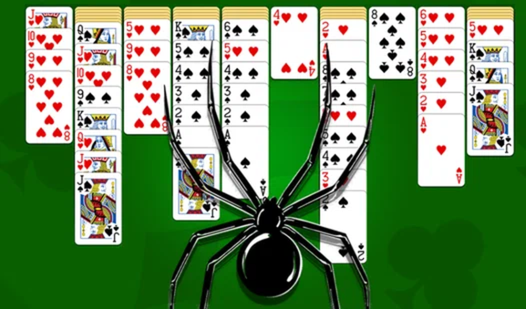
The starting layout follows a specific pattern that applies to every Spider Solitaire game, regardless of suit count:
The tableau — 10 columns:
- Columns 1 through 4: 6 cards each (5 face-down, 1 face-up on top)
- Columns 5 through 10: 5 cards each (4 face-down, 1 face-up on top)
That's 54 cards distributed across the tableau. The remaining 50 cards sit in the stockpile, off to the side.
Suit distribution in 2-suit mode: Hearts and spades are shuffled together and distributed randomly. At the start, you'll see one face-up card per column — 10 visible cards out of 104. The rest are hidden.
Empty columns (called "spaces") are incredibly valuable. An empty column lets you temporarily park any card or same-suit sequence while you rearrange elsewhere. Protecting your empty columns — and using them deliberately rather than reflexively filling them — is one of the most important skills in the game.
What you can't see matters. Face-down cards are unknown quantities. Part of the strategic game is mentally tracking which cards you've already flipped and where they are now. If you've seen both copies of a particular card go to completed sequences or locked positions, you know that rank isn't coming to help you elsewhere.
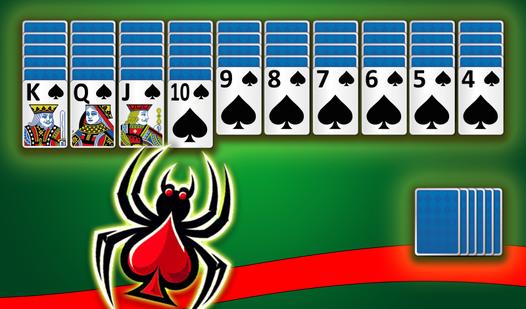
If you're new to the 2-suit format and want to see the setup in action, Spider Solitaire (1, 2, and 4 suits) is ideal. It lets you switch between all three variants from the same interface, so you can directly compare 1-suit's simplicity with the 2-suit challenge and understand exactly what changes.
Spider Solitaire (1, 2, and 4 suits)
Arrange descending sequences of the same suit from king to ace to clear the board. Spider Solitaire offers a classic card game experience with multipl...
▶ Play FreeWinning strategies for 2-suit Spider
Here's where the game separates casual players from consistent winners. The 2-suit variant has enough complexity that random good moves won't carry you. You need a coherent approach.
1. Commit to one suit first
The single most effective strategy in how to play Spider Solitaire with 2 decks is suit segregation. Pick one suit early — say, spades — and prioritize building clean spade sequences over everything else. Don't scatter your spades across five different columns while chasing short-term tidiness.
Mixed runs are the enemy of progress. A pure-suit run can be picked up and moved as a single block, giving you maximum flexibility throughout the game. A mixed run is locked in place, card by card, useless for creating space.
2. Uncover face-down cards aggressively
Every face-down card is an unknown risk. The faster you flip cards, the better your information. When you have a choice between two moves, prioritize the one that reveals a hidden card — even when another option looks tempting at first glance.
A column with 5 face-down cards underneath it is a liability. A column of all-visible cards is a resource you can actually plan around.
3. Treat empty columns like gold
Empty columns are the most powerful resource in Spider Solitaire. You need them to:
- Temporarily hold sequences while restructuring other columns
- Break apart a mixed run to sort by suit
- Parking spots for high-value cards while you build up to them
Never automatically park a King in an empty column. A King permanently occupies a space with no way to move it elsewhere. Empty columns should be used with purpose and reclaimed whenever possible.
4. Time your stockpile deals carefully
Before hitting the stockpile, scan the entire tableau. Ask:
- Are all 10 columns occupied? (Required before dealing)
- Can I squeeze any more productive moves out of the current state?
- Will the incoming 10 cards likely block or bury critical positions?
Each deal is a controlled disruption. New cards land on top of whatever's there now, potentially burying useful configurations. Get the tableau as clean as possible before dealing.
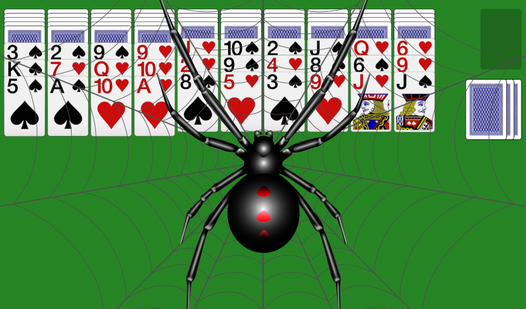
Maps - Solitaire Spider is a great environment to practice this timing. Its clear visual layout makes it easy to survey all 10 columns before making a decision, and the multiple difficulty levels let you build confidence before scaling up.
Maps - Solitaire Spider
Card game enthusiasts who enjoy a good mental workout will find Maps - Solitaire Spider the perfect companion for a quick break. This addictive challe...
▶ Play Free5. Think in sequences, not cards
Beginners move individual cards. Experienced players think in blocks. Before picking up any card, visualize where the sequence ends up and what that does to the surrounding columns. A move that looks productive in isolation might block three better moves that follow.
6. Prioritize moves in this order
When multiple moves are available, rank them:
- Same-suit sequence building — always first choice
- Moves that reveal a face-down card
- Moves that free or protect an empty column
- Legal moves that improve position without worsening it
Avoid "neutral" moves that accomplish none of the above. If a move has no clear benefit, skip it and keep looking.
7. Handle Kings deliberately
Kings are uniquely difficult because nothing can go on top of them. Best practices:
- Don't immediately place a King in an empty column unless you have its same-suit Queen ready to follow
- Pair Kings with their Queen as quickly as possible to prevent them sitting as lonely blockers
- If two Kings are competing for one empty column, prioritize the suit you're building
8. Watch the column dominance ratio
A useful mental check: count how many columns are primarily one suit versus heavily mixed. If 7 or more columns have clear suit dominance, you're in good shape. If most columns are random mixed piles, you're in trouble regardless of how many cards have moved.
Spider (4 suits) is worth a session once you're comfortable with 2-suit. Applying these same principles at the harder level sharpens your pattern recognition in ways that transfer back to 2-suit play.
Spider (4 suits)
Solitaire remains the undisputed king of patience games because it turns a simple deck of cards into a mental marathon that is impossible to put down....
▶ Play FreeCommon mistakes to avoid
Even players who know the rules well fall into these patterns. Recognizing them in your own gameplay is the fastest path to improvement.
Building mixed sequences intentionally
Stacking any card on any legal card feels efficient in the moment. It's not. Every mixed-suit sequence you deliberately build becomes a problem you'll need to solve later — often with empty columns you no longer have. Build mixed sequences only when forced to, and have a plan for untangling them.
Dealing from the stockpile too early
The stockpile is not a reset button. Each deal adds 10 more cards to an already complex situation. If your tableau is chaotic, dealing again just compounds the chaos. The stockpile is best used when you've genuinely exhausted useful moves and your tableau is reasonably organized.
Filling empty columns reflexively
Many players see an empty column and immediately put something in it — any card, just to "use" the space. Empty columns aren't gaps to plug. They're working capital. The moment you drop a lone King into a column and move on, you've spent a scarce resource with limited return.
Splitting focus across both suits equally
Trying to advance hearts and spades at the same rate usually means you complete neither. You'll make 60% progress on two suits and run out of stockpile before closing either. Pick the suit where you have better early card distribution and commit to it.
Making moves just because they're legal
"This move is legal, so why not" is a subtle trap. Not every legal move improves your position. Before moving anything, ask what specifically this move accomplishes. If the answer is genuinely nothing, hold off and search for something better.
Underestimating the endgame
Some arrangements look clean at 40 cards remaining but create an impossible situation with 10 left. Always ask: "Could I theoretically complete 8 full sequences from here?" If the answer is clearly no, look for a way to backtrack rather than continuing toward a known loss.
Solitaire Spider - Deluxe includes hint and undo features that are genuinely useful for spotting these mistakes in real time. Using hints as a learning tool — not a shortcut — helps you understand why certain moves are suboptimal.
Solitaire Spider - Deluxe
Card game enthusiasts who enjoy a good mental workout will find Solitaire Spider - Deluxe to be their new favorite pastime. This classic solitaire spi...
▶ Play FreeIgnoring card counts you already know
As the game progresses, you'll have seen cards go to foundations, watched sequences build and break, and tracked cards moving around the tableau. Use that information. If you know both copies of the 3-of-spades are already locked in mixed sequences, you know that building a spade run to 4 is currently impossible. Adjust your plan accordingly.
Best free Spider Solitaire games online
The best way to internalize all of the above is repetition in a good game environment. Here are the top free Spider Solitaire options to play right now — all browser-based, no account needed.
Spider Solitaire Cards offers clean, no-fuss gameplay with multiple difficulty settings. Start at 1-suit to warm up, then step to 2-suit once the strategic principles feel natural.
Spider Solitaire Cards
Staring at a blank screen during a midday slump is the worst, but a quick mental reset can change your entire outlook. Spider Solitaire Cards serves a...
▶ Play FreeSpider Solitaire - The Perfect Deal is a popular choice specifically because its deals are designed to be beatable. Great for working through strategy without the frustration of mathematically impossible layouts.
Spider Solitaire - The Perfect Deal
Arrange cards into descending sequences from King to Ace to clear the board in this engaging logic challenge. Spider Solitaire - The Perfect Deal test...
▶ Play FreeSpider Solitaire 2024 has a modern interface with crisp card design and smooth controls. It handles desktop and mobile equally well, which matters when you want a session while away from your main machine.

Spider Solitaire 2024
Staring at the clock waiting for your next meeting or just need a mental reset during a long afternoon? Spider Solitaire 2024 is the ultimate browser-...
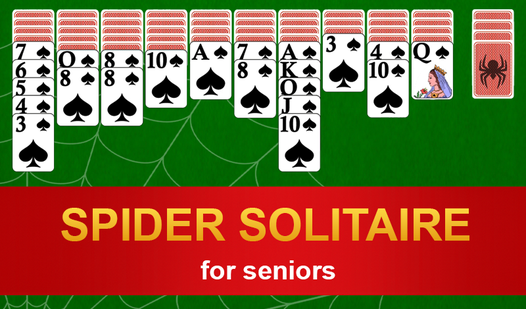
▶ Play FreeSpider Solitaire for Seniors deserves a mention beyond its target audience. The larger cards and cleaner suit colors reduce visual noise — which, it turns out, helps anyone think more clearly during complex mid-game arrangements.
Spider Solitaire for Seniors
Card games remain the gold standard for mental agility because they force the brain to recognize patterns and plan several steps in advance. Spider So...
▶ Play FreeSpider Solitaire "Classic" sticks to the visual style most players recognize from classic desktop versions. Same deal mechanics, same familiar look, zero learning curve on the interface itself.
Spider Solitaire "Classic"
Stack cards of the same suit in descending order from King to Ace to clear the board in this timeless challenge. Strategy is everything as you move ca...
▶ Play FreeScorpion Solitaire - Big Cards isn't standard Spider but belongs here for variety. Scorpion uses overlapping mechanics — sequence building, suit rules — but with different movement constraints that challenge your thinking in fresh ways and build skills that carry back to Spider.
Scorpion Solitaire - Big Cards
Solitaire fans who crave a brain-teasing challenge will find Scorpion Solitaire - Big Cards the ultimate test of their tactical patience. This version...
▶ Play Free