How to Play Solitaire Online — Beginner's Guide
If you've ever wondered how to play Solitaire but weren't sure where to start, you're in the right place. Solitaire is one of the most-played card games on the planet — familiar enough that most people have tried it, yet deep enough that mastering it takes real practice. The good news? You can play Solitaire games online free, right in your browser, no installation needed. This guide covers everything: the rules, the strategies, the best variants, and the best places to practice.
Solitaire Rules Explained Simply
Before you touch a single card, it helps to understand what Solitaire actually is. "Solitaire" isn't one game — it's a family of single-player card games built around sorting a shuffled deck into an ordered arrangement. The exact rules depend on the variant, but most share the same core concepts.
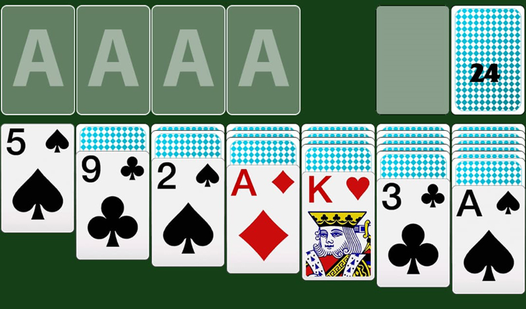
The four foundations sit in the top-right corner. Your goal is to fill each foundation with cards from Ace to King, sorted by suit (one pile per suit: ♠ ♥ ♦ ♣).
The tableau is the main playing area — usually seven columns of face-down cards with one face-up card on top. You move cards between columns to uncover buried cards and eventually send them to the foundations.
The stock is the remaining deck. When you run out of moves in the tableau, you draw from the stock to get fresh cards.
The waste pile is where drawn cards land when you can't immediately play them.
The general flow:
- Draw from the stock when stuck
- Move tableau cards to build sequences
- Flip face-down cards as they become exposed
- Whenever an Ace appears, move it to a foundation
- Build foundations up from Ace to King
Simple enough in theory. In practice, every shuffle presents a unique puzzle.
How to Play Klondike Solitaire
Klondike is the version most people picture when they hear "Solitaire" — it's the one that shipped with Windows 3.1 and introduced generations of people to the game. Learning how to play Solitaire usually means starting here.
Setup: Deal 28 cards into 7 tableau columns. Column 1 gets 1 card (face up), column 2 gets 2 cards (1 face down + 1 face up), column 3 gets 3 cards (2 face down + 1 face up), and so on. The remaining 24 cards form the stock.
Building the tableau: In Klondike, you build tableau columns in descending order with alternating colors. A red 7 can go on a black 8. A black Queen can go on a red King. You can move a King (or a sequence starting with a King) to any empty column.
Drawing from the stock: You can draw either 1 card at a time (easier) or 3 cards at a time (harder — only the top card of each three-card flip is playable). Drawing 3 at a time is the traditional Vegas-style rules and significantly increases difficulty.
Winning: Move all 52 cards to the four foundations, sorted by suit from Ace to King. The game is won the moment the last card lands on a foundation.
Key tips for beginners:
- Always move Aces and 2s to foundations immediately
- Try to clear columns early — empty columns are valuable because only Kings can fill them
- Don't rush moves to the foundation if keeping a card in the tableau helps you uncover face-down cards
- When drawing 3 cards, track which cards are buried — they cycle around
Klondike Solitaire
Card enthusiasts seeking a classic mental challenge will find their perfect match in Klondike Solitaire. This timeless puzzle tests your patience and ...
▶ Play FreeOne great way to try different drawing rules side by side is Solitaire for 1 and 3 cards — it lets you switch between drawing 1 card or 3 cards per turn, so you can feel the difference directly and pick the difficulty that fits your skill level right now.

Solitaire for 1 and 3 cards
Staring at a blank screen during a midday slump is the worst, but a quick round of Solitaire for 1 and 3 cards is the perfect mental reset. This class...
▶ Play FreeSpider and FreeCell — Alternate Solitaire Rules
Once you're comfortable with Klondike, the world of Solitaire opens up. Two variants that get a lot of play online are Spider Solitaire and FreeCell — both are very different from Klondike and from each other.
Spider Solitaire
Spider uses two full decks (104 cards total) and has no foundation pile until you build one. The goal is to build complete sequences from King down to Ace within the tableau — all in the same suit. When a complete sequence appears, it gets removed from the tableau. Clear all sequences to win.
Spider comes in three difficulty levels:
- 1 suit: All cards are Spades. Much easier — you can stack any card on any higher card regardless of suit.
- 2 suits: Cards are split between Spades and Hearts. Mid-difficulty.
- 4 suits: Full four-suit game. Sequences must be same-suit all the way down. This is brutal and satisfying.
The tableau has 10 columns and you deal additional cards from the stock (10 at a time, one per column) when you run out of moves. A key rule: you can only deal from the stock if every column has at least one card — no empty columns allowed when dealing.
Spider tips:
- Build same-suit sequences whenever possible, even in 1-suit mode — it keeps options open
- Try to empty columns completely; empty columns are like free spaces
- Don't deal from the stock too early — squeeze every possible move out of the current layout first
- In 4-suit games, try to isolate suits early and work one suit at a time
Spider Solitaire (1, 2, and 4 suits)
Arrange descending sequences of the same suit from king to ace to clear the board. Spider Solitaire offers a classic card game experience with multipl...
▶ Play FreeFreeCell Solitaire
FreeCell is fascinating because nearly every deal is theoretically solvable — unlike Klondike, where roughly 20% of deals are unwinnable no matter what you do. FreeCell is a game of skill, not luck.
Setup: Deal all 52 cards into 8 tableau columns (4 columns get 7 cards, 4 columns get 6 cards). All cards are dealt face up. You can see everything.
The four free cells in the top-left corner are temporary holding spots. You can move any single card into a free cell at any time. Think of them as short-term parking.
Building rules: Tableau columns are built in descending order with alternating colors — same as Klondike. But here, you can only move one card at a time unless free cells and empty columns give you "virtual" multi-card moves.
Winning: Send all cards to the four foundations (Ace to King by suit).
The challenge is managing your free cells without filling all four — once all cells and columns are jammed, the game locks up. Every move in FreeCell should be deliberate.
FreeCell tips:
- Plan several moves ahead before committing
- Keep at least one free cell empty at all times if possible
- Prioritize freeing up Aces and 2s
- Empty columns are more powerful than free cells — treat them carefully
FreeCell Solitaire 2024
Staring at a blank screen during your coffee break is the perfect sign that you need a mental refresh. FreeCell Solitaire 2024 offers the ideal escape...
▶ Play FreeWinning Strategies for Online Solitaire
Knowing how to play Solitaire is one thing — winning consistently is another. Here are the principles that separate good players from beginners.
Think Before You Move
The biggest mistake new players make is moving the first card they can move. Solitaire rewards patience. Before touching anything, scan the entire tableau:
- Which face-down cards can you flip?
- Which foundations can you build?
- Which moves open the most new options?
Move the card that creates the most opportunity, not just the first available move.
Prioritize Flipping Face-Down Cards
Every face-down card is potential. Flipping it gives you more options. As a general rule, prioritize moves that uncover face-down cards over moves that just rearrange face-up cards.
Manage Empty Columns Carefully
An empty tableau column is a premium resource. Only use it when you have a King ready to place, or when you need it as a temporary staging area to reorganize cards. Don't burn an empty column just because you can.
Don't Over-Commit to Foundations
This sounds counterintuitive — aren't foundations the goal? Yes, but sometimes sending a card to a foundation removes it from play when you needed it in the tableau. For example, if you have a black 3 in the foundation and both red 4s are buried deep in columns, sending a black 2 to the foundation locks out potential tableau moves.
As a rule of thumb: it's usually safe to send Aces and 2s immediately. For 3s and above, check if keeping them in the tableau would help first.
In Spider: Build Pure Suits
Mixed sequences in Spider are traps. They look like progress but they're hard to move as a unit. Always prefer building same-suit sequences, even if it means playing more carefully.
In FreeCell: Plan Your Outs
Before using a free cell, ask: how will I empty it? Free cells are not storage units — they're one-step buffers. Every card that goes into a free cell should have a clear path back into the tableau or directly to a foundation.
Solitaire Swift is a great game for practicing these principles — it offers a relaxed mode where you can learn without pressure, plus a timed mode once you want to test your speed and decision-making under constraint.
Solitaire Swift
Clear the board by matching cards one rank higher or lower regardless of their suit or color. Solitaire Swift keeps your brain sharp as you strategica...
▶ Play FreeBest Free Browser Solitaire Games to Practice
The best way to get better at Solitaire is to play — a lot. The good news is that you can play Solitaire games online free right now with no sign-up, no downloads, and no cost. Here are the top picks for different kinds of players.
For Beginners: Dreamland Solitaire
If you're brand new to the game and want something welcoming, Dreamland Solitaire is a great entry point. It plays classic Klondike rules wrapped in a beautiful, calming magical theme — it makes learning feel less like a tutorial and more like relaxing play. The visuals are polished, the cards are easy to read, and the flow is smooth.
Dreamland Solitaire
Fans of card games will find a new obsession in Dreamland Solitaire as it blends relaxing strategy with a charming magical aesthetic. Your main missio...
▶ Play FreeFor Klondike Fans: Solitaire Klondike Vegas
Once you know the basics, Solitaire Klondike Vegas adds a Vegas-style scoring system that makes each session feel higher-stakes. You draw 3 cards at a time and track your score against a simulated buy-in. It's a great way to push yourself to play more carefully.
Solitaire Klondike Vegas
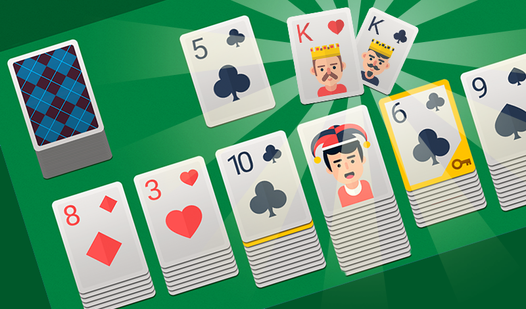
Sorting cards into perfectly ordered piles provides a satisfying mental workout that keeps you coming back for one more round. Solitaire Klondike Vega...
▶ Play FreeFor a Bigger Challenge: Double Klondike
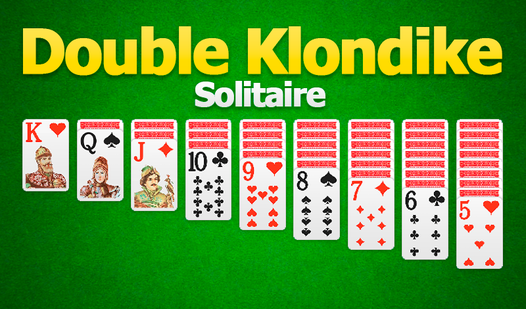
Double Klondike uses two full decks and scales up to 9 tableau columns. It plays by the same rules as Klondike but the added complexity means longer sessions and more interesting puzzles. Perfect if single-deck Klondike is starting to feel a bit easy.
Double Klondike Solitaire
Arrange cards by suit from Ace to King across eight foundation piles in this challenging variation of the classic card game. Double Klondike Solitaire...
▶ Play FreeFor Pure Relaxation: Solitaire: Relax & Easy
Sometimes you don't want a challenge — you just want a calm, clean game to unwind. Solitaire: Relax & Easy is exactly that. It's designed around the idea that Solitaire is also a form of mental rest, not just competition. No timer, no pressure, just cards.

Solitaire: Relax & Easy
Stack cards effortlessly by simply selecting from a trio of options while the system handles the tricky alignment for you. Solitaire: Relax & Easy rem...
▶ Play FreeFor Story-Driven Play: Magic Story of Solitaire
Magic Story of Solitaire wraps the classic card game in a narrative adventure. If you prefer your Solitaire with a side of story and progression, this one gives you a reason to keep coming back beyond just beating your high score.

Magic Story of Solitaire
Staring at a blank screen during a midday slump is the worst, especially when your brain just needs a quick, satisfying distraction. Magic Story of So...
▶ Play FreeFor Long Sessions: Solitaire Journey
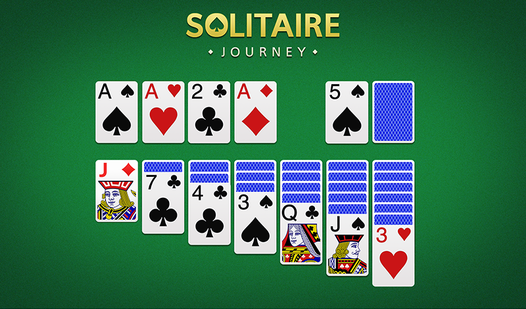
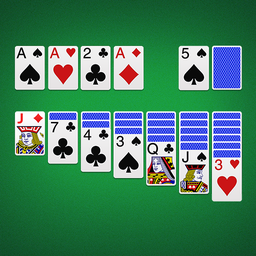
Solitaire Journey is built for extended play — it gives you a travel-themed progression with new levels and environments to unlock. Each stage is a fresh Solitaire puzzle, making it ideal for players who want variety without switching games.
Solitaire Journey
Arrange shuffle cards into descending sequences of alternating colors to clear the board in Solitaire Journey. This classic experience challenges your...
▶ Play FreePlaying Solitaire Online vs. Physical Cards
A quick word on why browser Solitaire has real advantages beyond convenience:
Auto-deal and auto-move: Most online versions will automatically move Aces to foundations and flag invalid moves, so you spend more time on real decisions.
Unlimited undos: Physical cards don't have an undo button. Online versions let you experiment and learn from mistakes without reshuffling.
Statistics: Many online Solitaire games track your win rate, best times, and streaks. Watching your win percentage climb over time is genuinely motivating.
Infinite deals: You'll never run out of shuffles. Some online versions even let you replay a specific deal — useful if you want to study whether a tricky deal was winnable or not.
Common Mistakes New Players Make
Before you head to the tables, here are the traps to avoid:
Moving without a plan. Solitaire looks simple but it punishes thoughtless play quickly. Take a moment before each move.
Ignoring the stock. New players sometimes get fixated on the tableau and forget to draw. If you're out of visible moves, draw.
Over-stacking tableau columns. Building long mixed sequences that you can't move is a common trap. Keep columns manageable.
Neglecting empty columns. Seeing an empty column and immediately filling it with a random card is a mistake. Save empty columns for strategic purposes.
Playing every FreeCell deal the same way. Each FreeCell deal is unique and requires its own solution. What worked last game may not work this game.