Bubble Hit Review: How to Play and Hidden Secrets
Few browser games can pull you in as quickly as a well-crafted bubble shooter, and Bubble Hit обзор proves exactly why the genre has never gone out of style. The premise is clean: shoot colored bubbles, match three or more of the same color, and clear the field before the ceiling closes in. That's all it takes to hook you. Ten minutes in, you're calculating bounce angles and planning three shots ahead. An hour later, you're wondering where the afternoon went.
What Is Bubble Hit? Full Обзор of the Game
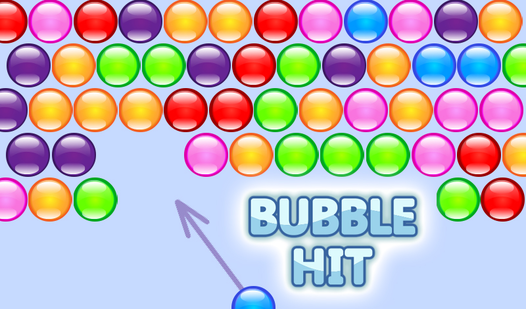
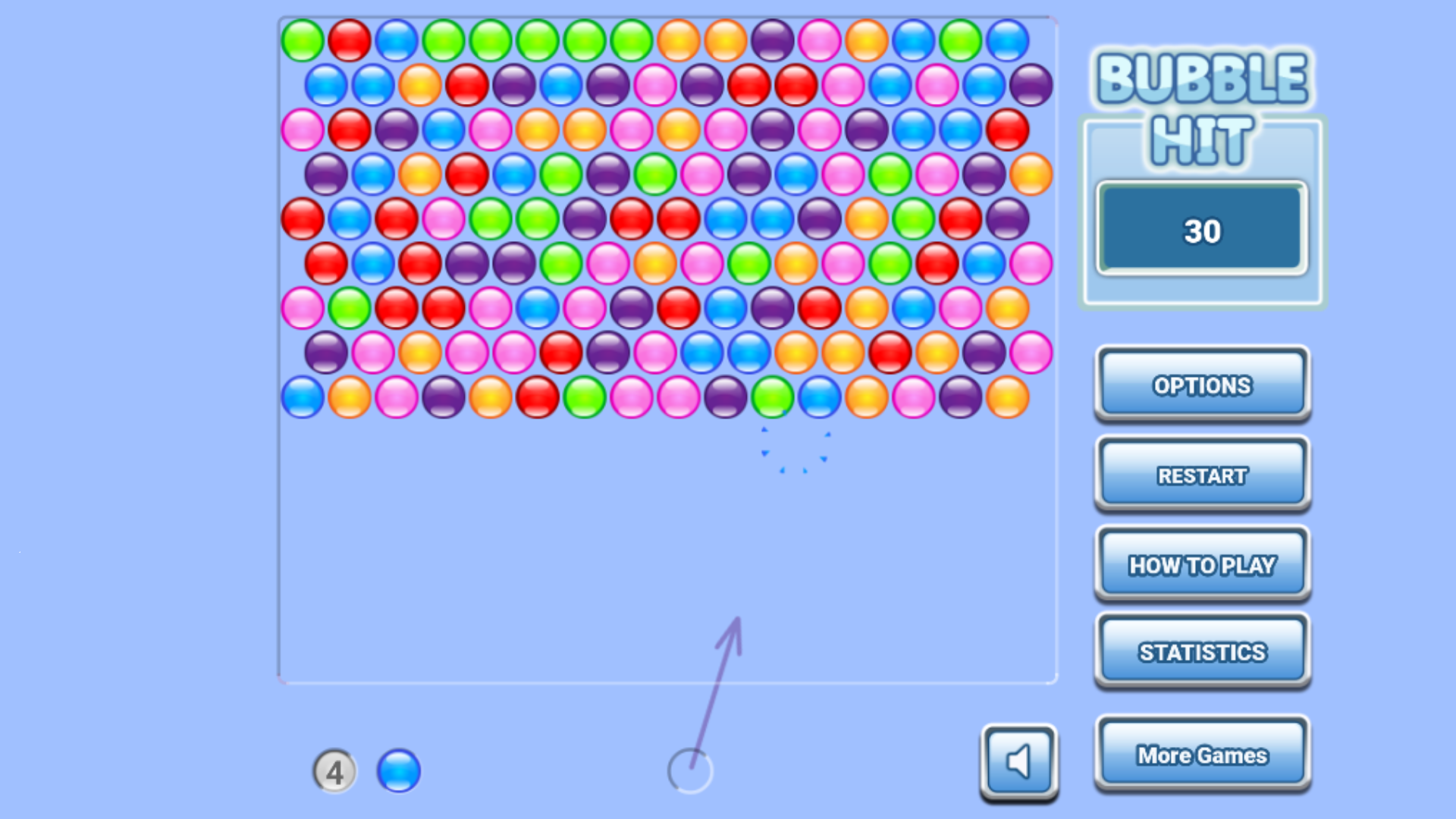
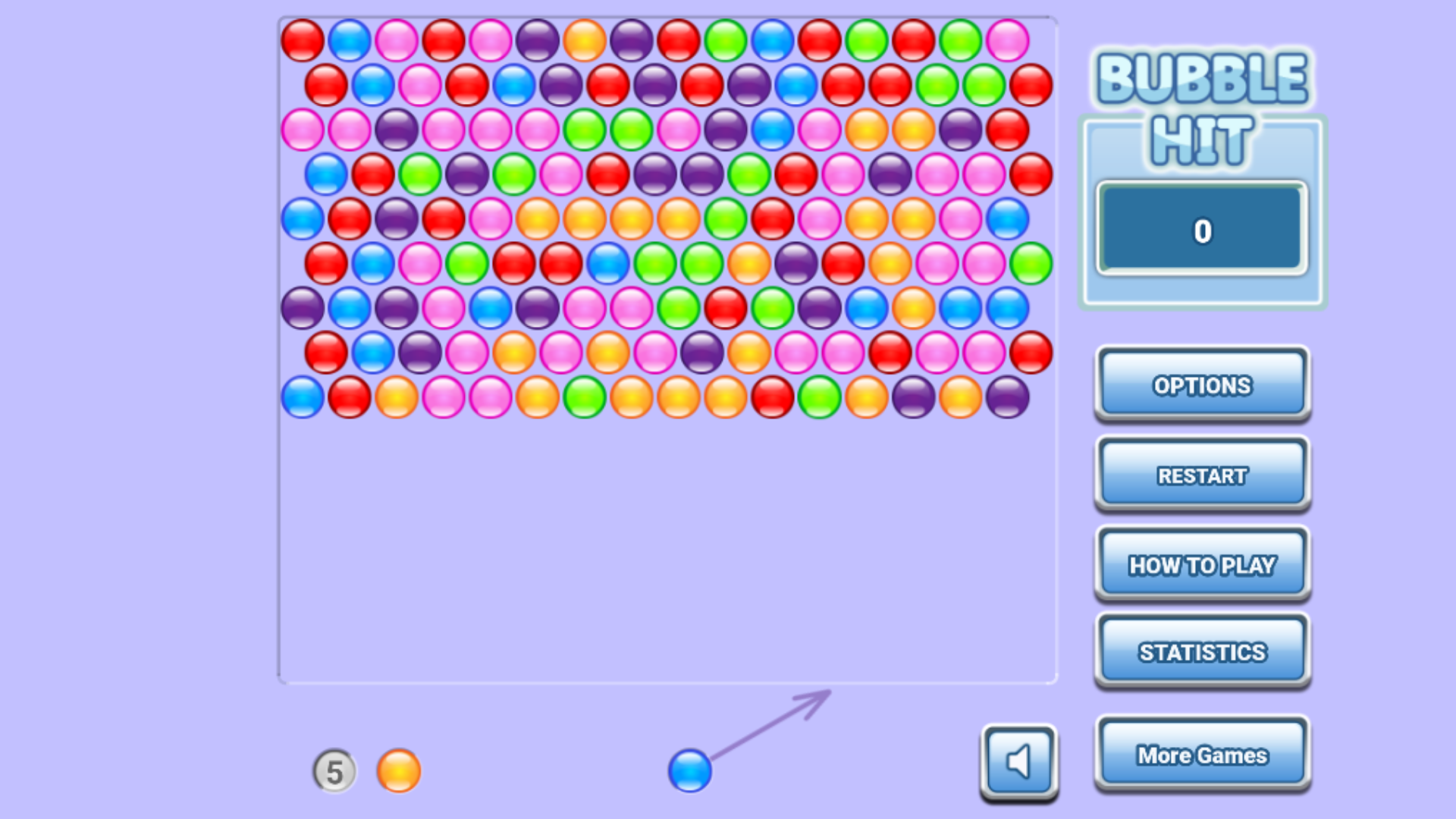
Bubble Hit is a browser-based arcade puzzle game built around one of gaming's most durable mechanics: the bubble launcher. You sit at the bottom of the screen with a colored bubble loaded and ready, a preview of what's coming next, and a field of mixed-color bubbles slowly creeping toward you from above. Your job is to clear that field faster than it fills.
The concept traces back to Puzzle Bobble (also known as Bust-a-Move), the 1994 arcade classic that defined the template. Bubble Hit is a modern browser interpretation of that formula — no download, no account, just open and play. What it brings to that familiar template is a level of polish that many free browser games skip: smooth physics, responsive controls, readable visuals, and a difficulty curve that earns your trust rather than abusing it.
The game doesn't bury you in systems. There are no stamina meters, no microtransaction paywalls, no complex upgrade trees. Just bubbles, a launcher, and increasingly demanding layouts. That restraint is a design choice worth appreciating. When a game trusts its core mechanic to be interesting enough on its own, it usually means that mechanic is genuinely good.
Visually, Bubble Hit keeps things clean and functional. Bubbles are bright, distinct, and easy to read at a glance — no straining to tell red from orange or blue from purple. Backgrounds stay muted enough to not compete with the action. The sound design delivers satisfying pops and chimes without becoming irritating after extended play. Everything adds up to a game that gets out of its own way and lets you focus on the puzzle.
The difficulty progression is honest. Early levels give you wide margins for error and plenty of easy matches. As you advance, clusters get tighter, color variety increases, and the field starts pressuring you harder. At no point does the difficulty feel random or unfair — if you lose a level, you can identify why. That cause-and-effect clarity is what makes good puzzle games replayable rather than frustrating.
Bubble Shooter: Bubble Puzzle Game
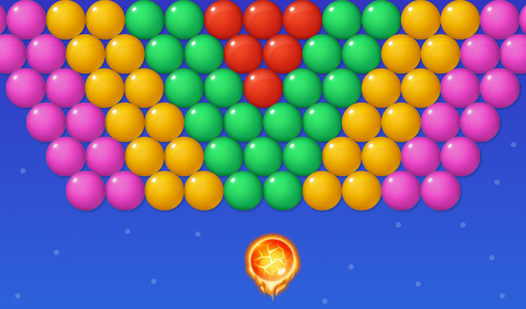
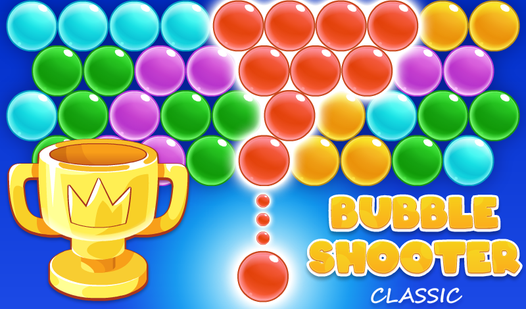
Need a quick mental escape from the daily grind? Bubble Shooter: Bubble Puzzle Game is your go-to for instant fun and satisfying puzzle-solving. This ...
▶ Play FreeBubble Hit Обзор: How the Core Mechanics Work
Understanding the mechanics in depth is the difference between playing Bubble Hit and playing it well. Here's what's actually happening under the hood.
The Launcher and Aim System
Your launcher is fixed at the bottom center of the screen. You aim by moving your cursor (on desktop) or dragging (on mobile), and a dotted trajectory line extends from the launcher to show your shot path. This guide is accurate — it accounts for wall bounces and shows you exactly where the bubble will travel. Use it. Even experienced players rely on it for tricky angles.
Two pieces of information are always visible: the bubble currently loaded and the next bubble coming up. These previews are the foundation of any real strategy. If you ignore them, you're playing reactively. If you plan around them, you're solving puzzles.
Grid-Based Placement
Bubbles in the field snap to a hexagonal grid. When your shot reaches the field, it locks into the nearest open grid position adjacent to an existing bubble. This matters because precise placement — slipping your bubble into a gap between two existing ones — can set up matches that a surface-level hit would miss.
Understanding the grid helps you aim more accurately. Instead of trying to hit "the red bubble," you aim for "the open space two positions left of the top-right red cluster." That level of precision is what separates clean efficient clears from messy ones.
Wall Bounces
The side walls reflect bubbles at the angle of incidence — a standard physics bounce. A bubble aimed at 45 degrees to the wall bounces out at 45 degrees. This is consistent and predictable every single time, which means it's learnable. Wall bounces are not a trick or a gimmick; they're a fundamental part of the aiming system that many players underuse.
Some shots are only possible via bounce. Clusters tucked in corners, bubbles shielded behind obstacles, matches that require approaching from an angle — these all call for wall shots. Players who only shoot straight lines are voluntarily playing with one hand behind their back.
Color Matching and Chain Drops
The basic rule: connect three or more bubbles of the same color to pop them. But the real depth comes from what happens after the pop.
When a group of bubbles is popped, any bubbles that were only connected to the field through that group lose their support. With no path to the ceiling, they fall entirely off the field — regardless of their colors. This is the chain drop mechanic, and it's the engine of high-level play.
A cluster of eight mixed-color bubbles hanging from a support group of three reds is worth targeting the reds, even if you could pop a larger matching group elsewhere. Pop the reds, and you get eleven bubbles cleared for three shots' worth of work. Recognizing these structural dependencies — which bubbles hold up which clusters — is the core skill of advanced Bubble Hit play.
Bubble Shooter: Bubble Tactics
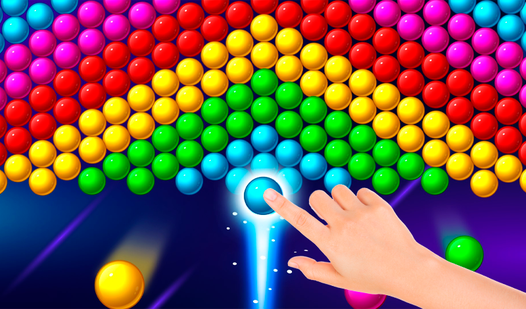
Matching colored spheres is one of the most satisfying ways to sharpen your focus during a quick break. Bubble Shooter: Bubble Tactics elevates this c...
▶ Play FreeThe Descending Ceiling
The bubble field doesn't stay static. Over the course of a level, the entire field descends toward you. Shoot slowly or waste too many shots, and bubbles will eventually cross the danger line at the bottom of the play area, ending the game.
This descent mechanic adds urgency without being punishing if you're playing at a reasonable pace. The ceiling typically moves slowly enough that a competent player can clear most of the field before it becomes a real threat. Where it starts to bite is when you're wasting shots — bubbles that don't match, attempts that miss, and shots fired without a plan all add up.
The ceiling is also why panic shooting is so counterproductive. When players see the field dropping, the instinct is to fire faster. Fast inaccurate shots miss more often, the wasted bubbles add to the field, and the situation gets worse rather than better. The ceiling rewards deliberate play.
How to Play Bubble Hit: Step-by-Step Guide
Whether you're completely new or just looking to sharpen up, here's a practical walkthrough of how to approach the game from your first shot.
Before You Shoot: Read the Field
Every level starts with a moment of setup. Before firing your first bubble, spend three to five seconds scanning the field. Where are the largest clusters? Are any clusters already close to a three-bubble match? Are there obvious support bubbles holding up large groups? Are there any gaps that would let you reach valuable positions?
This pre-shot read might feel slow at first, but it pays off immediately. Going in with a plan beats reacting shot-by-shot every time.
Use Both Bubble Previews
Your current bubble is your immediate resource. The preview bubble is your next decision. Before firing your current bubble, consider whether it's worth taking a slightly suboptimal current shot in order to leave the field in a better state for your next bubble.
For example: your current bubble is green, and you have a three-green match available in the center of the field. Your preview bubble is yellow, and there's a five-yellow cluster in the upper right that would cause a massive chain drop. Consider whether a "setup" green shot — one that parks the green somewhere useful — is worth it to position yourself for the big yellow play.
Prioritize High-Impact Shots
Not all matches are equal. Three bubbles popped at the bottom of the field is three bubbles gone. Three bubbles popped near the top that cause twelve bubbles to drop is fifteen bubbles cleared for one shot. Always ask what the downstream effect of a shot is before firing it.
High-impact shots almost always involve support bubbles connecting clusters to the ceiling. Learning to spot these structures quickly is what accelerates your improvement most dramatically.
Bubble Shooter: Bubble Line
Aim your launcher to create vibrant clusters of identical colors and watch your score skyrocket in Bubble Shooter: Bubble Line. This addictive bubble ...
▶ Play FreeWork Top-Down
As a general rule, clear from the top of the field down. Popping bubbles at the top causes drops; popping at the bottom just removes a few bubbles. Top-down play keeps your total bubble count low with fewer shots, which directly reduces how much the ceiling drops.
This doesn't mean ignoring everything at the bottom — sometimes you need to clear a path to reach upper clusters, or a bottom match has downstream effects that make it worth it. But your default priority should always be: how do I get to the top of the field?
Thread Shots Into Gaps
Bubbles lock into the first available grid position they reach. By aiming into gaps between existing bubbles rather than at their surfaces, you can place bubbles with much higher precision. This is especially important for single-bubble slots where you need an exact hit to make a match.
Take the time to trace your shot path carefully through gaps. Missing a gap shot wastes a bubble and potentially makes things harder; landing it can clear a strategic cluster you couldn't otherwise reach.
Keep Calm When the Ceiling Drops
If the ceiling starts dropping toward the danger line, the correct response is not to fire faster. The correct response is to find the single best shot available and execute it cleanly. One good shot clears more field than three panic shots. Breathe, aim, fire.
Bubble Hit Секреты: Advanced Tips and Hidden Tricks
These are the techniques that separate players who enjoy the game from players who master it.
The Support Bubble Strategy
Map the field structurally, not just by color. Every cluster has attachment points to the ceiling. Some clusters are held up by a single bubble. Find that bubble. If you can pop a small group that releases a much larger cluster below it, that's almost always the right play.
Start seeing the field as a load-bearing structure rather than a collection of matching opportunities. Which bubbles, if removed, would cause the most to fall?
Banking Complex Angles
Wall bounces allow you to reach positions that straight shots can't. But beyond just using bounces, you can use double bounces — reflecting off one wall, then another — for extremely precise placement in heavily defended corners. The trajectory guide only shows the first bounce in many versions, so the second bounce requires manual calculation.
Practice double-bounce shots in easy levels where the pressure is low. Once your eye calibrates to the angles, you'll automatically see these paths during harder levels.
Color Conservation
When you're getting repeated bubbles of one color, prioritize clearing that color's clusters efficiently. If you burn three green bubbles on a small green cluster because you didn't wait for a better angle, and then get three more green bubbles with nowhere useful to put them, you've wasted resources. When a color runs hot, be selective about where you spend it.
The Thinning Technique
When the field is dense and complex, resist the urge to chase big matches. Sometimes the right move is to thin the field — clear smaller clusters to open up sight lines to more valuable positions. A more open field gives you more angles, more options, and more visibility of support structures.
Predict the Next Impossible Shot
Occasionally you'll get a bubble color with no available match on the field. This happens more in later levels with higher color variety. When you see your preview bubble and recognize it as likely unmatchable, start planning where to park it with minimum disruption — somewhere that won't block future shots or add awkward blocking bubbles to clusters you're building toward.
Bubble Shooter: Colored bubbles
Aim and pop vibrant spheres by matching three or more of the same color to clear the board in this addictive bubble shooter. You must carefully calcul...
▶ Play FreeSimilar Games Worth Playing
If Bubble Hit has you hooked on the genre, the catalog on FreeJoy.games has strong options across the full spectrum of bubble shooting styles.
Bubble Shooter - Shoot and Burst!
A high-energy take on the classic formula with snappy feedback and a well-paced level structure. If you like Bubble Hit's fundamentals and want something with a bit more punch in the presentation, this is an excellent next step.
Bubble Shooter - Shoot and Burst!
Staring at a blank screen during a midday slump is the worst, but a quick round of Bubble Shooter - Shoot and Burst! turns that boredom into high-stak...
▶ Play FreeBubble Shooter Classic
For players who want the purest possible version of the genre — no extras, no gimmicks, just clean mechanics and honest difficulty. Bubble Shooter Classic is the genre stripped to its essentials. Sometimes that's exactly what you want.
Bubble Shooter Classic
Fans of addictive arcade puzzles will find their new obsession with Bubble Shooter Classic. This timeless test of precision challenges you to clear th...
▶ Play FreeMystic Bubble Shooter Quest
This one wraps the familiar gameplay in a fantasy adventure setting, giving you a sense of narrative progression as you clear levels. If you want your bubble shooting to feel like it's part of a bigger journey, Mystic Bubble Shooter Quest delivers that atmosphere well.
Mystic Bubble Shooter Quest
Matching colored spheres creates a satisfying sensory loop that keeps puzzle fans coming back for just one more round. Mystic Bubble Shooter Quest ele...
▶ Play FreeBubble Shooter Challenge
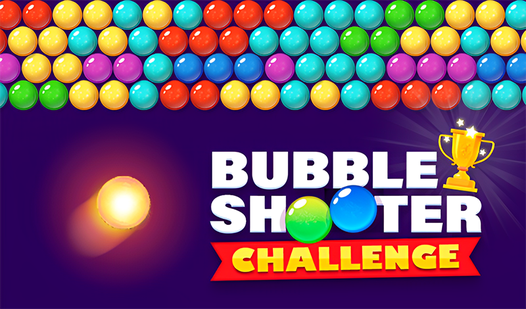
The name is honest. This is a tougher, more demanding take on bubble shooting that tests your bank shot precision and chain-drop awareness from early on. Recommended after you've got your fundamentals solid — this one will test them.
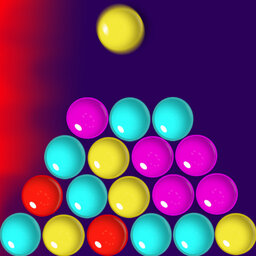
Bubble Shooter Challenge
Casual gaming addicts who crave a quick mental workout will find their new obsession in Bubble Shooter Challenge. This vibrant experience tests your s...
▶ Play FreeBubble Shooter 247
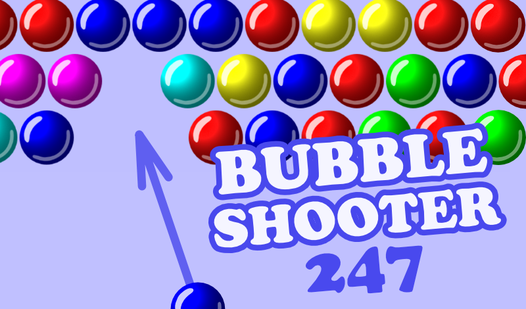
Built for players who want to keep coming back. The "247" in the name is the point — this game is designed for long-term, daily play with a progression system that rewards consistent sessions. A great companion game for when Bubble Hit is between your ears but you want variety.
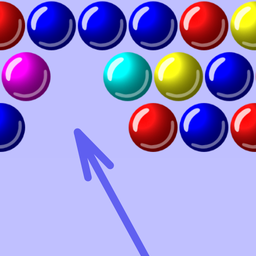
Bubble Shooter 247
Casual gamers who crave a satisfying logic challenge will find Bubble Shooter 247 to be the ultimate timekiller. This vibrant game tasks you with clea...
▶ Play FreeWhy Bubble Hit Works So Well
The bubble shooter genre is crowded. For every solid game there are dozens of clones that get the visuals right but miss the feel — sluggish physics, imprecise controls, unfair difficulty spikes, or UX that gets in the way of playing. Bubble Hit avoids all of these.
The physics are tight and consistent. The controls respond exactly as expected. The difficulty escalates on a curve that challenges you without making you feel cheated. And the zero-friction accessibility — browser-based, free, no account — means the game is always one click away when you want it.
There's also something genuinely satisfying about bubble shooters as a genre that goes beyond surface entertainment. The spatial reasoning involved in planning bounce shots, identifying structural clusters, and managing color resources engages real cognitive skills. It's not just a time-filler — it's a puzzle that rewards getting better at it, and Bubble Hit represents that at a high level.
The sign of a genuinely well-made arcade game is that "one more round" feeling. Bubble Hit has it in abundance.