How to Play Snake Games Online: Rules, Controls & Tips
Snake is one of those games that hooks you immediately — simple rules, zero learning curve, and yet somehow you're still playing "just one more round" twenty minutes later. If you want to know how to play Snake properly, you're in exactly the right place. This guide covers everything from the original mechanics to modern browser variations, control schemes for every device, smart beginner strategies, and the advanced tricks that separate good players from great ones.
Online Snake games free to play today offer far more variety than the classic Nokia phone game most people remember. You'll find multiplayer arenas, logic puzzles, hybrid genres mixing Snake with 2048 or base-building — all running directly in your browser with nothing to install.
Basic Snake Game Rules
The core concept hasn't changed since the 1970s: you control a snake moving through a bounded (or sometimes endless) grid. The snake constantly moves forward. Your job is to steer it — not stop it. Every time the snake eats a food item (typically a dot, apple, or glowing orb), it grows longer. The score climbs, the snake gets longer, and the challenge compounds.
You lose when:
- Your snake collides with a wall or border
- Your snake collides with its own body
- In multiplayer games — when you collide with another player's snake
That's the classic ruleset. Online Snake games have expanded this significantly. Some versions remove walls entirely and let the snake wrap around the screen edges (infinitely looping borders). Others add obstacles, moving hazards, or time-limited food that disappears if you don't reach it fast enough.
Food mechanics vary by game:
- Single food item at a time (the original)
- Multiple food items scattered across the map
- Special power-up items with bonus effects (speed boosts, score multipliers, length reduction)
- Food that moves or vanishes after a few seconds, forcing faster decisions
Understanding which ruleset you're playing with matters more than most beginners realize. A game with wrap-around borders plays completely differently from one with hard walls — the wrap version lets you use edges strategically, while hard walls turn every corner into a potential death trap. Spend your first thirty seconds figuring out what type of boundary the game uses before you start chasing food aggressively.
Object permanence with the tail: one concept that trips beginners up is forgetting that the tail moves. As the snake travels forward, the back end lifts off the squares it just occupied. A path that looks blocked by your own body might be open in a few seconds because the tail has moved through. Keeping this in mind is the difference between seeing dead ends everywhere and seeing timed opportunities.
One of the most popular multiplayer takes on classic Snake is Little Big Snake — it drops you into a massive online arena alongside hundreds of real players, where your snake grows by eating glowing orbs and the glowing remnants of defeated opponents. The multiplayer chaos makes standard "don't hit a wall" rules feel almost quaint because now the biggest danger is other humans.

Little Big Snake
Fans of classic arcade challenges and modern .io games will get hooked on Little Big Snake! This isn't your grandma's snake game; it's a vibrant arena...
▶ Play FreeControls for Browser Snake Games — How to Play Snake on Any Device
Most online Snake games support multiple control schemes because players arrive from desktops, laptops, tablets, and phones. Here's what you'll typically encounter:
Keyboard controls (desktop):
- Arrow keys — the default for most browser Snake games. Simple and reliable.
- WASD — common in more game-like implementations. W goes up, A goes left, S goes down, D goes right.
- Many games support both simultaneously, giving you the choice mid-session.
Mouse / cursor controls:
- Click-to-turn: click anywhere on the screen and the snake angles toward your cursor.
- Cursor tracking: the snake continuously follows your mouse direction. This style is dominant in .io-style multiplayer games where reaction speed matters.
Mobile / touchscreen controls:
- Swipe gestures: swipe in the direction you want the snake to turn. Natural and fast once you're comfortable.
- On-screen D-pad: virtual arrow buttons overlaid on the game screen. Less precise but reliable.
- Tap-to-turn: tap the left or right side of the screen to change direction. Some games use this simplified scheme.
One rule that trips up beginners on every device: you cannot reverse direction in most Snake games. If your snake is moving right, pressing left does nothing — or worse, causes an instant self-collision in some implementations. This constraint is intentional game design. You're always planning where you're going next, not just reacting to what's right in front of you.
Puzzle Snake games handle controls differently because you're not in a real-time flow. You're thinking move by move, planning sequences. Alphabet Lore: Snake is a strong example — each move you make determines the next segment of the path, and the goal is to reach a specific endpoint successfully. There's no rushing. The controls are as simple as it gets, but the thinking required is genuinely challenging.
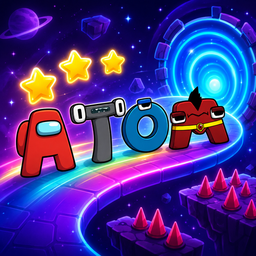
Alphabet Lore: Snake
Fans of logic challenges and alphabet lore will find this charming puzzle adventure impossible to put down. Navigating the snake across the grid requi...
▶ Play FreeSnake Escape takes yet another angle. This one is about logic and spatial reasoning rather than reflexes at all. You're solving a puzzle about how to free the snake within a constrained environment. The controls are minimal; the brain work is the whole game. Playing both this and classic arcade Snake in alternating sessions is a surprisingly effective way to build different parts of your Snake skill set.

Snake Escape
Staring at a blank screen during a midday slump is the worst, but finding the right mental spark can turn your mood around instantly. Snake Escape off...
▶ Play FreePro tip for keyboard players: keep your fingers lightly resting on the arrow keys or WASD before you need them. Reactive key presses — reaching for a key when you suddenly realize you need it — are slower than pre-positioned ones. When you know a turn is coming, have your finger already touching the key. The difference is maybe 100-200 milliseconds, which sounds tiny until you realize that's exactly how fast most deaths happen.
Pro tip for touchscreen players: swipe from the center of the screen rather than the edges. Swiping from edges can accidentally trigger browser navigation gestures and pull you out of the game mid-run.
Beginner Strategies for How to Play Snake Without Dying in 10 Seconds
If you're new to Snake games online, the first few sessions feel brutally short. Here's how to survive longer and build a real foundation before the score gets interesting.
Hug the walls early
At the start, your snake is short and the grid feels enormous. Use that open space wisely by staying near the edges. The center of the board becomes risky as your snake grows because a longer snake easily blocks off center sections. Hugging walls keeps your movement predictable and leaves the rest of the field available.
Think in patterns, not reactions
The biggest beginner mistake is purely reacting. "Oh, food! Turn! Oh, wall! Turn!" That approach works when your snake is tiny. Once you're medium-length, purely reactive play reliably gets you killed. Start thinking one or two moves ahead. Where is the food? What path reaches it without boxing yourself in? Does the route leave an exit if you need one?
Don't rush the food
You don't have to grab food the second it appears. Most classic Snake games don't time-limit food items. Take the longer, safer route to food if the short route puts you in a risky position. The extra length you gain from speed-rushing isn't worth dying thirty seconds earlier than you would have otherwise.
Always leave yourself an escape route
Every time you turn, ask: if I need to change direction again immediately, can I? If the answer is no, you're approaching a trapped position. Beginners spiral inward without noticing — suddenly the snake has nowhere to go and the only option is running into yourself.
Practice with puzzle Snake variants
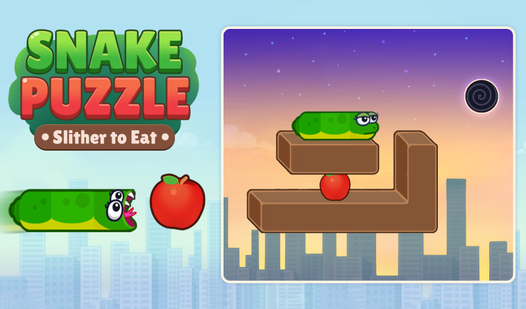
Puzzle-style Snake games are excellent training for spatial thinking. Snake Puzzle: Slither to Eat! forces you to plan exact routes for a snake to eat apples and grow longer, with each puzzle adding more complexity. Working through those challenges builds the ahead-thinking pattern that keeps you alive in classic Snake when your length makes reactive play impossible.
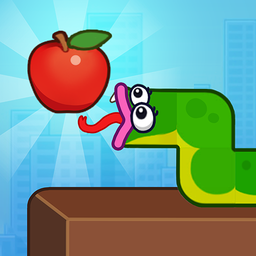
Snake Puzzle: Slither to Eat!
Stuck in a boring meeting or just waiting for your coffee to brew, you need a quick mental escape that actually stimulates your brain. Snake Puzzle: S...
▶ Play FreeWatch your tail, not just your head
Beginners focus entirely on the snake's head. Experienced players also track the tail. Your tail is constantly clearing squares as it moves — what looked like a blocked path five seconds ago might be accessible now. This awareness opens options you'd otherwise write off as dead ends.
For multiplayer Snake — ignore the big players early
A large snake can eliminate you just by turning into your path. When you're fresh into a multiplayer session with a tiny snake, stay away from large opponents entirely. Find a quiet corner of the map, eat safely, grow to a respectable size, and only then consider competing for territory or making aggressive plays.
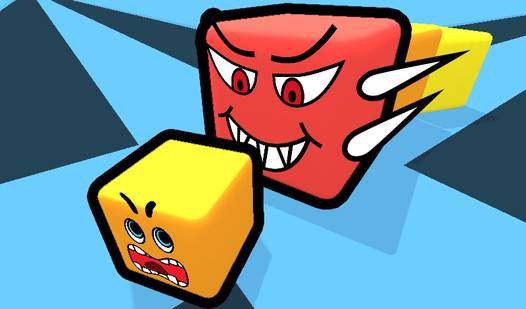
Noob Snake 2048 is a genuinely forgiving starting point for newcomers who want a fresh angle. The hybrid Snake-plus-2048 format gives you more to think about strategically, but less pressure from pure speed-based survival. It's a good confidence builder for players who keep dying quickly in classic modes.
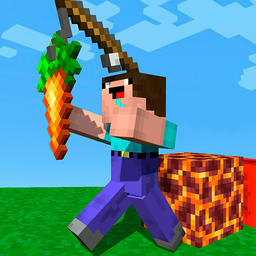
Noob snake 2048
Slither your way to numerical dominance by merging blocks in the addictive world of Noob snake 2048. You control a growing cube creature that merges w...
▶ Play FreeAdvanced Techniques for High Scores
Once survival is comfortable, the gap between surviving and scoring well opens up wide. Here's how to close it.
The coiling technique
This is the single most important advanced skill in classic Snake. As your snake gets very long, move in controlled, progressively shrinking spirals. Start at the outer edge of the available space and work inward. Done correctly, you never cross your own path because you know exactly where your tail is at every moment — it's always one row over in the spiral behind you.
Think of it like mowing a lawn in concentric rectangles. Start at the outside, work your way in, and you never need to cross a section you've already covered. The coiling technique is what allows players to reach maximum snake length in games that have one.
Predict food spawns
In many Snake implementations, food spawns randomly but only in playable space — meaning not on top of the snake's body. Pay attention to where food tends to appear. If you've been filling the top half of the board, new food will likely appear in the bottom half where there's open space. Route toward that region proactively rather than waiting to react when you see the food pop up.
Use opponent snakes as walls (multiplayer)
Large snakes create de facto walls just from their body length. You can use this — position yourself near a large opponent's body to block smaller snakes from approaching you from that direction. It's a way of having a defensive barrier you didn't have to create yourself.
The trap play in multiplayer
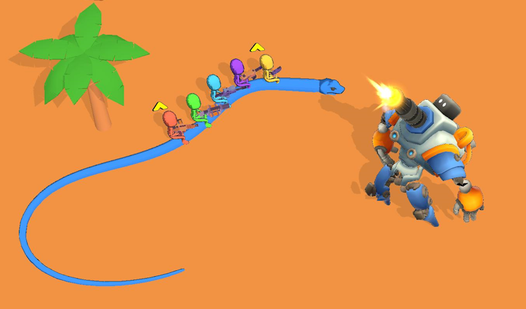
High-risk, high-reward. If you're large enough, you can loop around a smaller snake and close the loop, forcing them to run into your body. The timing has to be precise and the smaller snake has to not see it coming. Army on Snake: Robots Attack builds on exactly this kind of perimeter thinking — you're using snake movement to create defensive formations against robot waves while managing the snake's growth simultaneously.
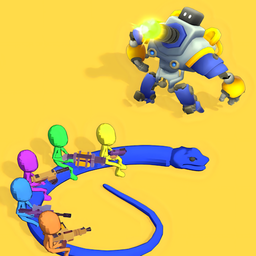
Army on Snake: Robots Attack
Modern warfare meets the classic arcade snake genre in a high-stakes battle for survival against mechanical invaders. Controlling a growing squad of s...
▶ Play FreeSpeed management
Some Snake games let you hold a button to boost movement speed temporarily. Boosts are essential for cutting off opponents or grabbing contested food in multiplayer, but they're dangerous near your own body or in tight spaces. Use boosts in open stretches or for quick escapes — never while making sharp turns or navigating your own coils.
2048-style hybrid strategy
In games like Snake 2048 or Ball Snake 2048, strategy shifts significantly. You need to think about which numbered tiles to collect and in what sequence to merge them effectively, while also managing the snake's path. The best players in these games treat snake movement as secondary to merge planning — they route the snake to collect specific values rather than eating anything nearby.
Snake 2048
Staring at the clock waiting for a break to end is never fun when you just need a quick distraction. Snake 2048 turns those idle moments into a high-s...
▶ Play FreeSharpen reflexes with action variants
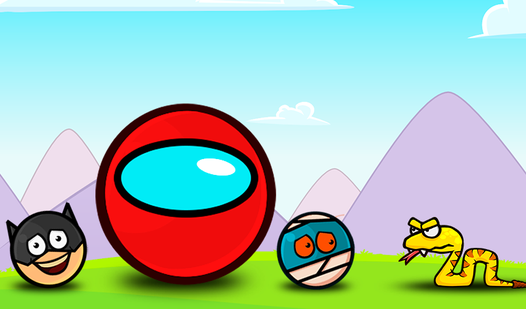
Genre mashups can develop specific skills. Red Ball vs Snakes puts snake mechanics in a more action-oriented context — playing it keeps directional reflexes sharp and builds comfort with quick direction changes under pressure.
Red ball vs snakes
Platformer fans know that nothing beats the thrill of a high-speed chase where every bounce counts toward survival. Red ball vs snakes puts your refle...
▶ Play FreeSnake: A Call to the Digital Circus brings a creative visual twist that forces you to apply classic muscle memory to unfamiliar aesthetics. Playing variants like this stops your brain from going fully on autopilot and keeps you actively thinking about your movement choices.

Snake: a call to the digital circus
Navigate a colorful arena to collect glowing apples while growing your character in Snake: a call to the digital circus. This fast-paced experience bl...
▶ Play FreeThe patience paradox
Here's something counterintuitive: the players with the highest scores in classic Snake are often the slowest deliberate movers, not the fastest reactors. They don't rush food. They don't take risky shortcuts. They build long, clean spirals and accumulate food at a measured, controlled pace. Aggressive play gets you killed at length 30. Patient, deliberate play gets you to length 200.
Speed and reaction time matter in multiplayer. For high-score solo Snake, patience and spatial planning are the actual skills.
Analyze every death
After each run ends, spend five seconds figuring out exactly what killed you. Was it a reaction you made too late? A spiral that closed in on itself because you miscounted rows? A wall you forgot about while chasing food? A boost you triggered at the wrong moment? Every death is a data point. Players who analyze their mistakes improve steadily. Players who just restart and hope for different results plateau.
High score chasing vs. competitive multiplayer
These are genuinely different skill sets that happen to share the same basic mechanic. High score solo Snake is an endurance test — patience, coiling, and space management over a long session with no external disruption. Competitive multiplayer Snake is closer to a sport — reading opponents in real time, timing aggressive cuts, managing risks against other live players who are actively trying to eliminate you.
The best Snake players online tend to be competent at both but excellent at one. Identify which style suits you and train for it specifically rather than trying to be equally good at everything from day one.