How to Play Japanese Games: Rules, Strategies & Tips
If you've ever wondered how to play Japanese games and why they're so addictive, you're in the right place. The Japanese gaming tradition spans thousands of years — from ancient board games to intricate logic puzzles — and today you can enjoy all of it for free, right in your browser. This guide covers the rules, strategies, and best free picks to get you started.
What Are Japanese Games?
The word "Japanese" covers a surprisingly broad category. Think nonograms (also called picross), mahjong, shogi, tangram puzzles, and dozens of themed titles inspired by Japanese culture and design philosophy. What unites them is a commitment to clean mechanics, elegant visuals, and a satisfying sense of progression.
These games didn't become globally popular by accident. Japanese puzzle designers built systems that reward patience and logical thinking — qualities that transfer perfectly to digital play. Whether you prefer quiet solo puzzle-solving or the strategic depth of a classic board game, there's a Japanese title that fits.
Types of Japanese games you'll find online:
- Nonograms / Picross — grid-based logic puzzles where numbers reveal a hidden picture
- Mahjong — tile-matching game with deep strategic roots
- Shogi — Japan's answer to chess, with a unique piece-promotion system
- Tangram — geometric shape puzzles with origins in ancient Japan
- Japanese crosswords — a specific nonogram variant with crossword-style clue layouts
How to Play Japanese Crosswords (Nonograms)
Nonograms are probably the most popular "Japanese" game format online. Here's the core rule set:
The grid: You get a rectangular grid — typically 5×5 for beginners, scaling up to 25×25 or larger. Each row and column has a clue: a sequence of numbers.
The numbers: Each number tells you how many consecutive filled cells appear in that line. If a row clue reads 3 2, it means there's a block of 3 filled cells, then a gap of at least one empty cell, then a block of 2.
Your goal: Fill in the correct cells to reveal a pixel-art picture hidden in the grid.
Basic solving logic:
- If a clue number equals the full line length, fill the entire row or column
- Overlap technique: when a block must appear somewhere in a range, the overlapping portion is definitely filled
- Cross-reference rows and columns constantly — each confirmed cell unlocks new information

Yamabusi. Japanese Crosswords
Logic puzzle enthusiasts will find endless satisfaction in Yamabusi. Japanese Crosswords as they unravel hidden images through careful deduction. This...
▶ Play FreeReading the clues correctly is where most newcomers stumble. Each number in a clue is separated by at least one empty cell from the next block — there's no minimum gap size stated, but the gap must exist. Get that rule wrong and your grid falls apart fast.
Marking empty cells: Most nonogram interfaces let you right-click (or long-press on mobile) to mark a cell as definitely empty. Use this aggressively. An X in a cell is just as valuable as a filled square — it eliminates possibilities and speeds up solving.
How to Play Mahjong (Online Version)
Online mahjong is almost always the solitaire variant (Mahjong Solitaire), not the four-player game from Chinese and Japanese traditions. The rules are simple but the strategy runs deep.
The setup: 144 tiles are stacked in a specific pyramid layout. Each tile has a symbol — characters, bamboo, circles, winds, dragons, flowers, or seasons.
The rule: You can only remove a tile if it's "free" — not covered by another tile on top, and open on at least one side (left or right). Tiles must be removed in matching pairs.
Winning: Clear all tiles from the board.
Sounds easy? The trap is that greedy play gets you stuck. Remove the wrong pair early and you'll lock yourself into an unwinnable board state with 20 tiles left. The key is to think several moves ahead.
Core mahjong strategies:
- Before removing any pair, check if one tile from that pair is blocking others you'll need later
- Prioritize uncovering tiles that are buried deep in the stack
- Flowers and seasons tiles match any other flower or season — use them as emergency unlocks
- If you see only two of a tile type and one is buried, the other is useless right now — focus elsewhere
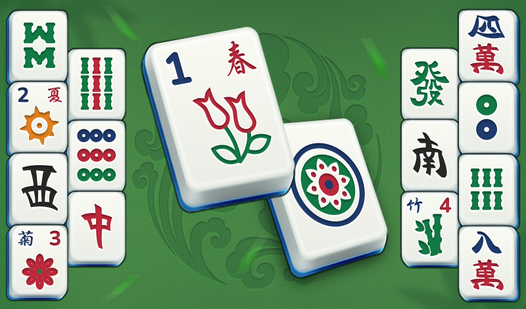
Vita Mahjong 2025
Matching ancient symbols has remained one of the most intellectually satisfying ways to unwind after a long day. Vita Mahjong 2025 elevates this class...
▶ Play FreeHow to Play Shogi (Japanese Chess)
Shogi shares DNA with Western chess but has one rule that changes everything: captured pieces switch sides. When you capture an opponent's piece, you can drop it back onto the board as your own piece on any future turn.
The board: 9×9 grid. Each player has 20 pieces of 8 types.
Piece movement basics:
- Fuhyō (Pawn): One square forward
- Kyōsha (Lance): Any number of squares forward only
- Keima (Knight): L-shape jump, forward only
- Ginsho (Silver General): One square in any of the 5 diagonal and forward directions
- Kinsho (Gold General): One square in 4 orthogonal directions + 2 forward diagonals
- Kakugyō (Bishop): Any number of squares diagonally
- Hisha (Rook): Any number of squares orthogonally
- Ōshō / Gyokushō (King): One square in any direction
Promotion: When a piece enters the opponent's back three rows, it can promote — flipping to reveal a stronger movement set. Most pieces promote to move like a Gold General.
The drop rule is everything. In chess, material advantage is permanent. In shogi, a captured rook never disappears — it waits in your hand, ready to drop into any empty square and wreak havoc. This means the game never slows down and comebacks are always possible.
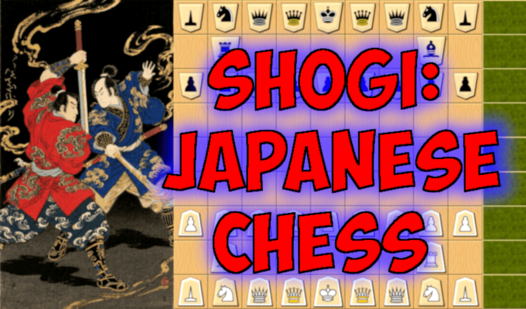
Shogi: Japanese Chess
Shogi is a legendary strategy challenge that brings the ancient tradition of japanese chess to your screen with a unique twist. Unlike Western chess, ...
▶ Play FreeBeginner shogi tips:
- Don't just attack — build a fortress around your king first (castle formations)
- Use pawns aggressively: they're the most flexible dropped piece
- Promoted rooks and bishops (called Dragon and Horse) are extremely powerful — promote whenever safe
- Watch your opponent's hand as carefully as the board
How to Play Japanese Tangram Puzzles
Tangram is a dissection puzzle: seven geometric pieces (called "tans") that fit together to form a perfect square. Your task is to rearrange all seven pieces to match a given silhouette.
The seven pieces: 2 large right triangles, 1 medium right triangle, 2 small right triangles, 1 square, 1 parallelogram.
The rules are strict:
- Use ALL seven pieces — no extras, no missing pieces
- Pieces cannot overlap
- Every piece must lie flat (no 3D stacking)
Strategy for tangram:
- Identify the large shapes in the silhouette first — they're almost certainly filled by the two large triangles
- The parallelogram is the only piece with an irregular shape; its position is often forced
- Work from the outside edges inward
- If you're stuck, flip the parallelogram — it looks the same but behaves differently when rotated
How to Play Japanese Nonograms (Advanced Techniques)
Once you've got the basics, these techniques unlock harder puzzles fast:
The "leftmost-rightmost" overlap method:
Imagine a row that's 10 cells wide with a clue of 7. The block of 7 can start at cell 1 (ending at 7) or at cell 4 (ending at 10). Cells 4 through 7 are filled in either case — that's your guaranteed overlap.
Contradiction scanning: Try mentally placing a block at the leftmost position. If that forces a conflict with your known column data, eliminate that position. Work rightward until only valid placements remain.
Color marking: Many solvers use two colors — one for "definitely filled" and one for "possibly filled." This helps you track uncertainty without committing to wrong answers.
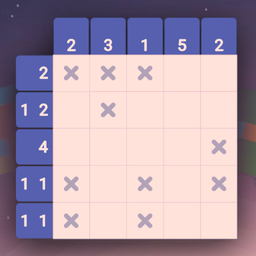
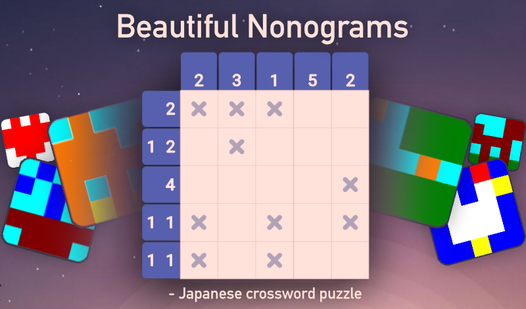
Beautiful Nonograms - Japanese crossword puzzle
Reveal hidden pictures by filling in cells based on numerical clues found along the grid edges. Beautiful Nonograms provides a meditative experience w...
▶ Play FreeWhen puzzles have multiple solutions: Most well-designed nonograms have exactly one solution. If you're stuck and the puzzle seems to allow two valid states, double-check your earlier deductions — a mistake is almost always the culprit.
Strategies That Work Across All Japanese Puzzles
Despite the variety, these principles apply broadly:
1. Don't rush. Japanese puzzle design rewards deliberate play. A wrong move in a nonogram means erasure time. A greedy tile removal in mahjong means a stuck board. Pause, scan, then act.
2. Work with certainty. Only mark or move when you're sure. Guessing in a nonogram cascades into multiple errors. In shogi, an overextended attack that fails leaves you a piece down.
3. Use the elimination mindset. Every piece of information tells you what's NOT possible as much as what is. Mark empty cells. Track which tiles remain. Know what your opponent cannot do.
4. Learn one game deeply before spreading wide. Nonograms alone have enough depth to keep you busy for years — there are puzzles up to 50×50 cells. Mastering one format sharpens the pattern recognition skills that transfer to others.
5. Replay and review. After finishing a puzzle, look back at the first move that was definitely forced. Training your eye to see forced moves instantly is the fastest path to improvement.

The Shogun nonograms
Fans of brain-teasing challenges and artistic expression will find their new obsession in The Shogun nonograms. These logic games invite you to uncove...
▶ Play FreeBest Free Japanese Games to Play Right Now
Here's a quick rundown of the strongest picks available for free online:
Yamabusi: Japanese Crosswords — a polished nonogram collection with clean grid presentation and a good difficulty curve from 5×5 all the way to large grids. Perfect starting point for the puzzle type.
Beautiful Nonograms — if aesthetics matter to you, this one delivers. The solved pictures are genuinely beautiful, and the interface is smooth on both desktop and mobile.
Shogi: Japanese Chess — a proper shogi implementation with clear piece visualization. The promotion rules and drop mechanics are handled intuitively, making it accessible even if you've never seen the piece names before.
Japanese Puzzle: Tangram — clean, minimal tangram with a good variety of silhouettes ranging from animals to traditional Japanese symbols.
Nonogram: Japanese Puzzle — another strong nonogram entry with a different visual style and its own puzzle library. Great if you've burned through Yamabusi and want fresh content.
More Japanese-themed games worth your time:

Sakura Branch
Rotate scattered wooden fragments to reconstruct a majestic Sakura Branch and watch as it bursts into vibrant life. Sakura Branch challenges your logi...
▶ Play Free
Cozy Mahjong
Match identical tiles and clear the board in Cozy Mahjong, a relaxing online puzzle experience designed to unwind your mind. Swipe or click to select ...
▶ Play FreeWhere to Play Japanese Games for Free
All the games in this guide are playable for free at FreeJoy — no registration, no downloads, no installs. Just open the page and play. This matters more than it sounds: nonograms especially benefit from jumping in and out quickly during short breaks. Having them load instantly in a browser tab is genuinely useful.
The platform works on desktop and mobile, so a mahjong session during a commute is just as smooth as a long nonogram evening at your computer.