How to Play Matching Games: Rules, Tips & Free Fun
Matching games are one of the most satisfying genres in casual gaming — and if you've ever wondered how to play Matching properly, you're in the right place. From Matching правила to smart стратегии, this guide covers everything: how these games work, what separates casual players from high-scorers, and where to find the best free Matching онлайн titles without spending a cent. Whether you're brand new to the genre or looking to sharpen your skills, read on.
What Is Matching — and Why Is Everyone Playing It?
At its core, a matching game asks you to identify and connect identical or related elements on a board. That sounds simple, but the genre spans an enormous range of mechanics: tile-pairing puzzles, color-sorting challenges, merge chains, mahjong layouts, emoji sorters, and much more. The common thread is pattern recognition — spotting what belongs together and acting before the board fills up or the timer runs out.
The genre has exploded in popularity because it hits a rare sweet spot. Matching games are easy to learn in under a minute, yet they reward careful thinking and can keep experienced players busy for hours. They're also perfect for short sessions — you can put one down mid-level and come back without losing your place mentally.
From a psychological standpoint, matching gives players a clean, satisfying feedback loop: spot a pair, connect it, watch it disappear, see your score climb. That small burst of satisfaction is deeply compelling, which is why matching games consistently rank among the most-played genres in browser and mobile gaming.
Key varieties you'll encounter:
- Tile-match — clear a board by connecting identical tiles (think mahjong-style layouts)
- Sort & stack — group items by category into containers or shelves
- Merge chains — combine identical pieces to create higher-tier items
- Emoji/icon sorters — match symbols across a grid or conveyor
Let's look at how each type handles its rules, so you know exactly what to expect when you load one up.
Matching Rules and Basics: How to Play Matching Step by Step
Tile-Pair Matching
The classic format. A grid of face-down or face-up tiles is presented. Your job is to find two tiles that share the same image, number, or symbol and select them in sequence. If they match, they're removed from the board. If they don't, both flip back (in memory variants) or you lose points.
Core rules:
- Tiles must be identical (or follow the game's specific pairing rule)
- Some games require a clear connecting path between tiles — you can't match pieces that are fully blocked
- Most versions limit the number of wrong guesses or have a timer
Sort & Stack Matching
Here the board is cluttered with mixed items, and your goal is to sort them into the correct containers — shelves, boxes, tubes, or lanes. You score by filling each container with matching types.
Core rules:
- You can usually only move one item at a time
- Temporary holding slots are often limited — use them wisely
- Many levels have a move limit, so random clicking won't work
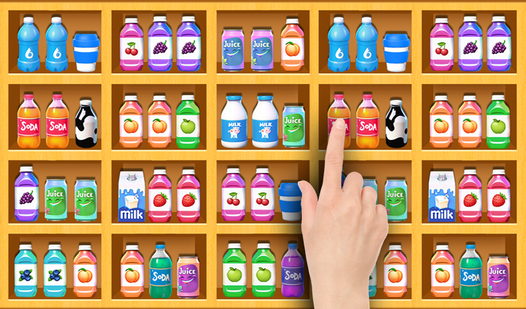
Goods Sort: Matching Items by Shelves is a perfect example of this subtype. Products tumble onto the screen and you must drag each one to the right shelf before space runs out. It sounds easy on level 1; by level 10, you'll be planning three moves ahead.
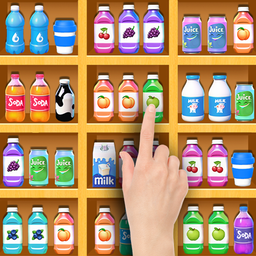
Goods Sort: Matching Items by Shelves
Organize cluttered spaces by dragging various items onto shelves to create perfectly tidy displays. Goods Sort: Matching Items by Shelves offers a sat...
▶ Play FreeMerge-Chain Matching
Instead of removing matched pieces, you combine them to create a new, higher-value item. Match two Level-1 gems → get one Level-2 gem. Match two Level-2 gems → get one Level-3 gem. The board gradually simplifies as items ascend the merge chain.
Core rules:
- You can only merge identical items
- Board space is finite — don't fill it randomly or you'll deadlock
- Usually no timer, but limited moves or board space creates pressure
Mahjong-Style Path Matching
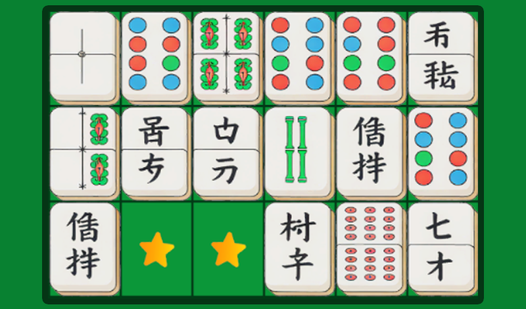
Tiles are stacked in complex 3D or 2D layouts. You can only select a tile if it has at least one free side (left or right) and nothing sitting on top of it. Match two free tiles to remove them and expose the ones beneath.
Core rules:
- Both selected tiles must be "free" simultaneously
- Planning which tiles to expose is just as important as matching
- Some versions add sliding mechanics — tiles shift when neighbors are removed
Strategies and Tips for Matching — How to Actually Win
Once you understand the rules, here's where most casual players stop. But Matching стратегии go much deeper. Apply these and you'll notice the difference immediately.
1. Scan Before You Click
Resist the urge to tap the first pair you see. Spend 3–5 seconds looking at the full board first. In sort games, identify which container is closest to full. In mahjong games, find which tiles are blocking the most others. Starting with the highest-impact move beats starting with the easiest one.
2. Work from the Center Out (Mahjong)
In layered mahjong layouts, tiles in the center and on top are usually blocking the most others. Clearing central stacks first opens up options everywhere. Edge tiles tend to be the "easy" picks — save them as backup when you're stuck.
3. Don't Waste Temporary Slots
Most sort and stack games give you 2–3 temporary holding slots. These are a lifeline, not a dumping ground. Keep at least one slot empty at all times so you can maneuver when a tricky piece arrives.
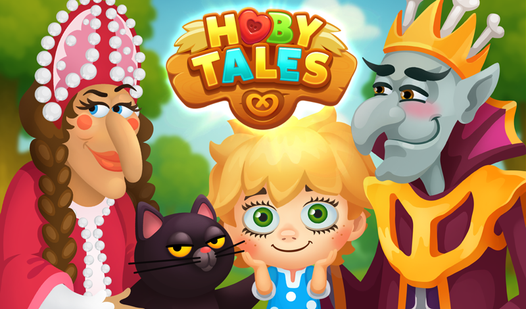
Hoby Tales illustrates this brilliantly. The game drops puzzle items into a shared tray and you must match them before the tray overflows. Players who burn all three slots early almost always lose the level. Players who treat the slots as emergency reserves usually clear it.
Hoby Tales
Stuck in a meeting that's dragging on, or just need a quick mental escape during a busy day? Hoby Tales is your perfect antidote for those moments whe...
▶ Play Free4. Chain Merges Deliberately
In merge games, don't just combine anything that's combinable. Ask: what do I need on the board right now? If you're close to a Level-5 item that unlocks a special ability, focus your merges there. Scattered merges create a messy board; focused merges build toward powerful outcomes.
Cat Voyage is a great merge game to practice this on. You're sailing with a cat crew, merging items to unlock new gear and progress the map. The players who treat every merge as part of a plan sail smoothly; the ones who merge at random quickly run out of board space.

Cat Voyage
Who knew the sea held so many secrets and a treasure trove of merging fun? Cat Voyage invites you on a whimsical underwater expedition unlike any othe...
▶ Play Free5. Read the Level Goal Before You Start
This sounds obvious, but many players ignore the goal panel and just start clicking. Some levels want you to clear specific tile types. Others want you to fill a container to a certain level. Others have a score threshold. Knowing the goal changes which moves are worth making.
6. Use Shuffles and Hints Sparingly
Power-ups are usually limited. Use a hint only when you've genuinely scanned the board for 10+ seconds and found nothing. Use a shuffle only when you're truly deadlocked, not just because the board looks messy. Burning power-ups on easy spots leaves you helpless on hard ones.
7. Match Rarest Items First
In boards where some items appear only twice and others appear dozens of times, match the rare ones first. If you only have two yellow stars on the whole board, find and clear them early. Common items will stay accessible; rare ones might get blocked.
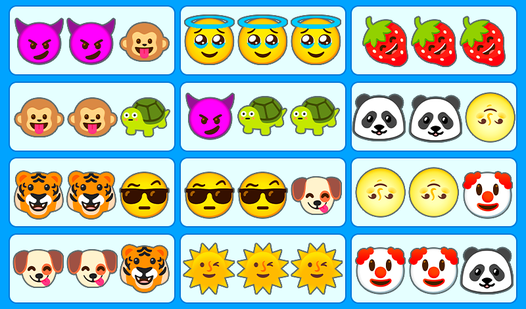
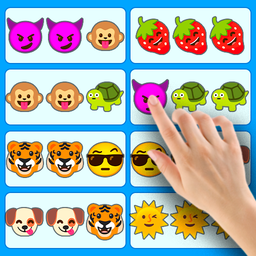
Put in place: Emoji Sorting constantly tests this principle. The emoji grid mixes very common faces with rare specialty symbols. Clearing the rare symbols first keeps your options open; ignoring them until late often means they end up buried under unmovable tiles.
Put in place: Emoji Sorting
Fans of brain-teasing challenges will find their new obsession in Put in place: Emoji Sorting. This addictive puzzle experience tasks you with organiz...
▶ Play FreeBest Free Matching Games Online
Now for the fun part — actual game recommendations. All of these are free, browser-based, and playable instantly on FreeJoy with no sign-up required.
Tiles Slider: Combine
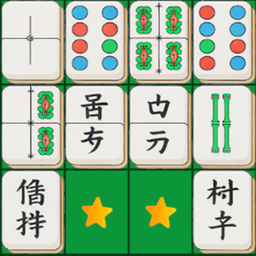
A card-matching game on a sliding board. Cards shift when you drag rows or columns, and you need to line up identical cards so they snap together and disappear. It adds a spatial reasoning layer on top of standard matching — you're not just finding pairs, you're engineering the board position to make the pair possible.
Great for players who love chess-adjacent thinking combined with match satisfaction.
Tiles Slider: Combine
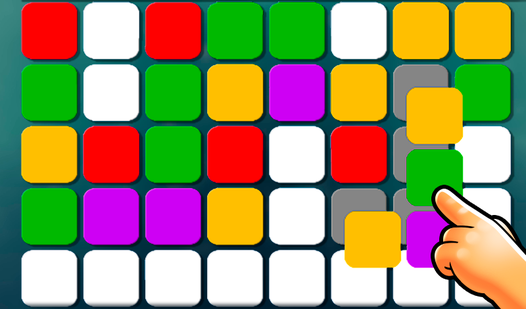
Match pairs on a bustling 6x7 board by sliding tiles into position to clear the screen. Tiles Slider: Combine challenges you to spot identical images ...
▶ Play FreeOceanscapes — Secrets of the Lost Treasures
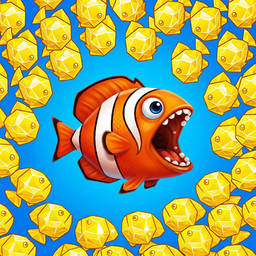
An underwater-themed tile-matcher with hidden treasures buried under layers of ocean debris. Clear tiles to reveal artifacts and fill your collection. The theming is gorgeous and the match mechanic stays crisp throughout.
Oceanscapes - Secrets of the Lost Treasures
Swap shimmering underwater tiles to create explosive combinations and clear your path through mysterious ocean depths. Oceanscapes - Secrets of the Lo...
▶ Play FreeColor Block Blast
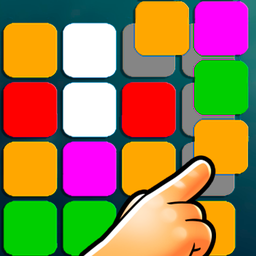
A color-sorting blaster where you fire blocks into columns and must match three or more of the same color to clear them. Fast-paced, great for short sessions, and increasingly tricky as new colors and obstacles get introduced.
Color Block Blast
Matching games have a way of turning a dull afternoon into a high-stakes strategic showdown. Color Block Blast elevates this experience by forcing you...
▶ Play FreeMerge and Blast + 2048
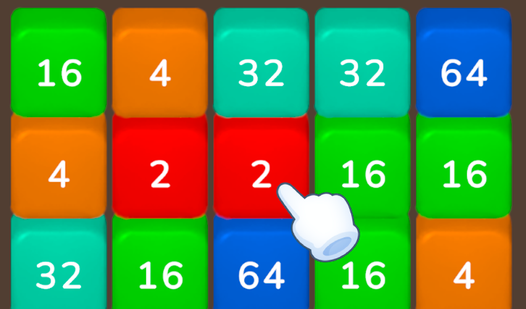
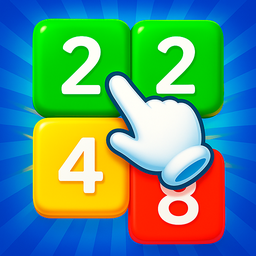
This hybrid combines merge-matching with the number-doubling logic of 2048. Identical numbered tiles combine into higher values — but you also need to blast tiles off the board by reaching target numbers. It's genuinely two games in one and rewards players who can think in both modes.
Merge and Blast + 2048
Staring at the clock and waiting for your next meeting to start is the ultimate boredom test. Merge and Blast + 2048 serves as the perfect digital esc...
▶ Play FreeMister Mahjong
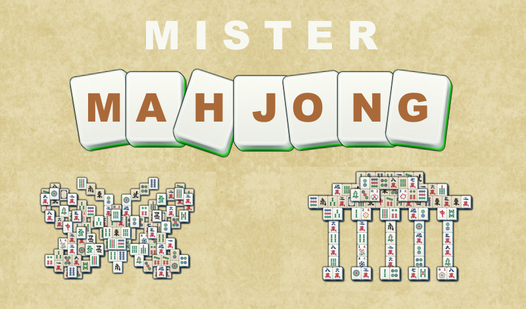
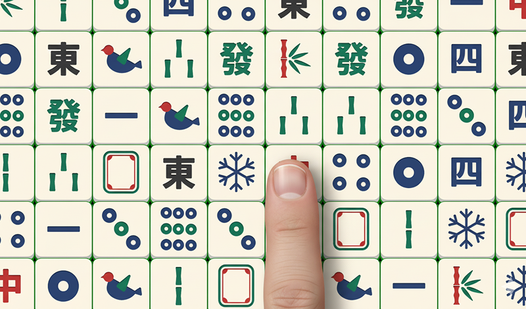
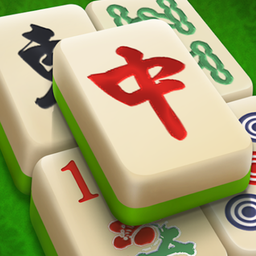
A polished, classic mahjong tile game with clean visuals and a relaxed pace. No gimmicks — just a well-designed layout, crisp tile art, and satisfying clearing sound effects. Perfect if you want to practice the fundamentals of mahjong matching without distractions.
Mister Mahjong
Ancient tile-matching puzzles remain the ultimate way to sharpen your focus after a long day. Mister Mahjong delivers a relaxing experience where you ...
▶ Play FreeGrill Party!
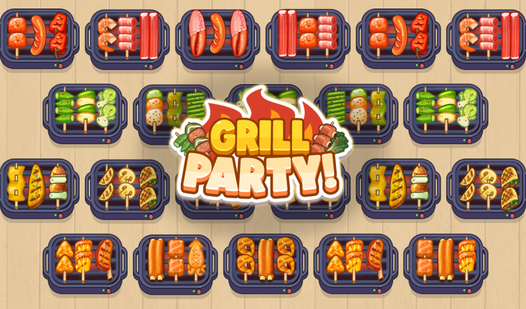
A food-themed matching game where you sort ingredients and complete grill orders by matching the right items to the right slots. It's casual and cheerful but gets surprisingly complex once multi-ingredient orders start stacking up.

Grill Party!
Nothing beats the heat of a backyard cookout, especially when you can master the culinary chaos of Grill Party! without getting your fingers greasy. T...
▶ Play FreeMahjong Slide & Merge
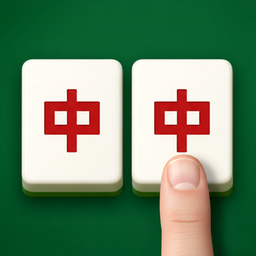
This one adds a slide mechanic to traditional mahjong: tiles don't just sit in place — they shift when others are removed, opening new matches dynamically. The merge component means matched tiles sometimes combine rather than disappear, adding a strategic layer that standard mahjong lacks.
Mahjong Slide & Merge
Slide tiles across the board to align identical pairs in Mahjong Slide & Merge, a fresh take on the traditional tile-matching challenge. You navigate ...
▶ Play FreeWhy Matching Games Are Good for Your Brain
This isn't just a fun genre — it's genuinely beneficial mentally. Regular matching play is associated with:
- Improved working memory — tracking which tiles you've seen and where they are
- Faster pattern recognition — training your visual system to find similarities quickly
- Better planning — sort games in particular demand multi-step forward thinking
- Stress relief — the clean, contained nature of match puzzles is genuinely calming
The genre is often recommended for players who want a brain workout without the stress of competitive or action games. You're solving real puzzles, but the stakes stay low and the pace is yours to control.
Common Mistakes to Avoid
Even experienced players fall into these traps:
Matching the first thing you see. This is the #1 beginner mistake. Always survey the board before moving. The first match that catches your eye is rarely the most strategic one.
Ignoring the edges. In sort games, items pile up around the edges of the board and get overlooked. Periodically scan the corners — often there's a match hiding there.
Over-relying on undo. Many games give you an undo button, and it's tempting to use it constantly. Better to train yourself to think before each move so you need it less. Undo buttons often have limited uses.
Playing too fast. Speed feels productive but costs you matches. Matching games reward calm, deliberate play almost every time.
Not replaying levels. If you cleared a level but barely scraped through, replay it. Understanding why you struggled helps more than grinding through to the next one.