How to Play Flash Games: Rules, Tips & Free Picks
Flash games defined an entire era of online gaming. If you've ever wondered how to play Flash games — what makes them tick, how to get good at them fast, and where to find the best ones for free — you're in the right place. This guide covers everything from the basics of Flash-style gameplay to smart strategies that'll help you beat levels, rack up high scores, and actually enjoy the experience instead of rage-quitting on level three.
Whether you're coming back to this genre after years away or discovering it for the first time, the appeal is the same: fast, accessible, surprisingly deep games that you can pick up in seconds and put down whenever you want. No installs. No subscriptions. No nonsense.
What Is Flash Gaming and Why Does It Still Matter
The term "Flash" originally referred to Adobe Flash Player — a browser plugin that powered most online games through the 2000s and early 2010s. Adobe officially discontinued Flash support at the end of 2020, but the genre it created never died. Hundreds of games originally built in Flash have been converted to HTML5, preserved through projects like Ruffle, or reimagined with the same design philosophy: lightweight, browser-based, instantly playable.
When people ask how to play Flash games today, they usually mean one of two things:
- Classic Flash-era games preserved and playable through emulators or conversion
- Flash-style games — modern browser games that follow the same design principles: simple controls, quick sessions, skill-based progression
Both are valid, and both are thriving. The spirit of Flash gaming — pick up and play, no commitment required — turned out to be exactly what the internet wanted, and that hasn't changed.
The Flash Game Philosophy
What made Flash games special wasn't the technology. It was the design discipline that the format imposed. A Flash game had to:
- Load fast (slow loading meant players left)
- Explain itself quickly (no lengthy tutorials)
- Reward skill without demanding hours of grinding
- Be completable in a session, or offer natural stopping points
These constraints produced some of the most elegantly designed games ever made. When you understand this philosophy, you understand how to play Flash games effectively — because the designers optimized for your enjoyment from the first click.
Rules and Basics: How to Play Flash Games
Here's the thing about Flash game rules: they're almost always simple by design. The complexity lives in the execution, not the ruleset. Let's break down the universal rules that apply across most Flash and Flash-style games.
Control Schemes
Most Flash games use one of three control schemes:
Mouse-only: Click, drag, and release. Common in puzzle games, physics games, and point-and-click adventures. Your precision with the mouse determines everything.
Keyboard-only: Arrow keys or WASD for movement, spacebar for actions. Classic for platformers, shooters, and rhythm games.
Mouse + keyboard hybrid: Move with keys, aim with mouse, fire with click. Popular in action and shooter games.
Before you start any session, spend thirty seconds identifying which control scheme the game uses. Many frustrating "difficult" moments in Flash games are actually just the player fighting unfamiliar controls.
Lives, Continues, and Checkpoints
Flash games vary widely here. Some offer unlimited retries with no penalty. Others give you a fixed number of lives and send you back to the start when they run out. Know which type you're playing before you take risks.
General rule: In games with limited lives, be conservative early. In games with unlimited retries, experiment aggressively — failure costs you nothing except time.
Scoring Systems
Many Flash games use points as their core feedback loop. Understanding the scoring system is how to play Flash games better than the average player. Common scoring mechanics:
- Time bonuses: Finishing faster nets more points
- Combo multipliers: Chaining actions without breaks multiplies your score
- Accuracy bonuses: Fewer mistakes = higher score
- Collectibles: Hidden items boost your score ceiling
If you're playing for enjoyment, ignore the score entirely and focus on completion. If you want to compete with others or beat your own records, study the scoring system first.
One game that captures this "pick up instantly" energy perfectly is Robby Speed Flash — a fast-paced arcade experience where your reaction time is everything. The controls are dead simple, but staying alive as speed increases is a genuine challenge that keeps pulling you back.

Robby speed flash
Staring at the clock during a long afternoon usually means it is time for a quick boost of adrenaline. Robby speed flash is the ultimate solution when...
▶ Play FreeStrategies That Actually Work
Beyond knowing the rules, there's a layer of strategy that separates players who clear games from players who get stuck on the same level for weeks. Here's what works.
Read the Level Before You Act
In puzzle and physics-based Flash games, the biggest mistake players make is acting immediately. Take five to ten seconds to analyze the screen. Where are the obstacles? What's the goal? What resources do you have? A moment of observation saves multiple failed attempts.
This is especially true in games with limited attempts or scores that penalize mistakes. The best Flash players think before they click.
Learn the Rhythm
Action and arcade Flash games almost always have patterns. Enemies follow routes. Obstacles appear on timers. Platforms move in predictable cycles. Once you recognize the rhythm, what seemed chaotic becomes manageable.
Practical tip: Let the game play out for one cycle without touching anything. Watch what happens. Then engage with full knowledge of the pattern.
Prioritize Survival Over Score (At First)
When learning a new Flash game, focus on completion before optimization. Survive to the end. Understand the full game. Then go back and chase high scores or perfect runs. Players who optimize too early get stuck on early sections while missing context from later levels that would change their strategy.
Use the Sound
Many Flash games embed important cues in their audio. A warning sound before a spike trap. A different music tempo signaling an incoming wave. The sound of a collectible nearby. Playing with sound on gives you information that purely visual players miss.
Take Breaks Strategically
Flash games are designed to be quick, but that doesn't mean powering through a frustrating section for an hour is effective. If you've failed the same moment five or six times, step away for a few minutes. Return with fresh eyes. This works far better than most people expect, and it's one of the least-used strategies in the Flash gaming toolkit.
For players who want something more educational alongside their gaming sessions, Flashcards for Children is worth exploring. It uses the "Flash" concept in a completely different way — quick visual memory challenges that train pattern recognition. Skills that transfer surprisingly well to game play.

Flashcards for children
Parents seeking effective early childhood development tools will adore the interactive world of Flashcards for children. This engaging platform uses v...
▶ Play FreeGenre-Specific Tips for Flash-Style Games
Different Flash game genres reward different strategies. Here's a quick breakdown.
Platformers
- Learn the jump physics before anything else — every platformer has different jump arcs
- Don't rush; rushing causes falls that careful movement avoids
- Look for patterns in enemy placement — they're almost never random
- In games with momentum physics, start your jump slightly earlier than feels natural
Puzzle Games
- Work backwards from the goal state when stuck
- Don't overlook the obvious — Flash puzzle designers often hide solutions in plain sight
- If a puzzle seems impossible, you've probably missed a mechanic; restart and observe everything
Arcade/Action Games
- Master one movement technique at a time rather than trying to do everything at once
- Understand your invincibility frames if the game has them — many Flash games do
- Prioritize positioning over aggressive play; surviving longer matters more than dealing damage
Tower Defense / Strategy
- Early investment in strong defenses is almost always better than spreading resources
- Identify which enemy type is the biggest threat and counter that first
- Don't save resources for later rounds; use what you have to survive the current one
Best Free Flash Games to Play Right Now
Theory is useful, but the real point is to play. Here are the best free Flash-style games available on FreeJoy right now, with notes on what makes each one worth your time.
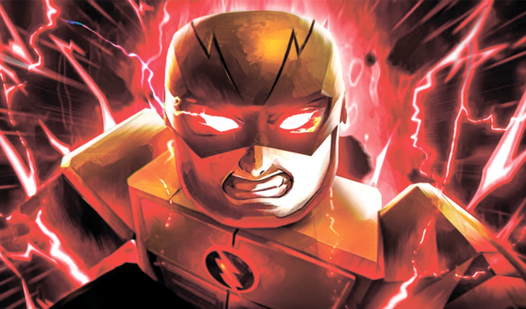
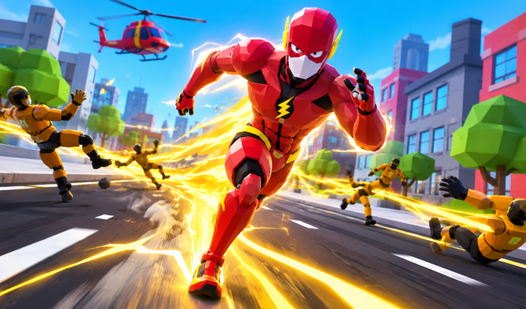
Hero 2: Flash — Super Speed
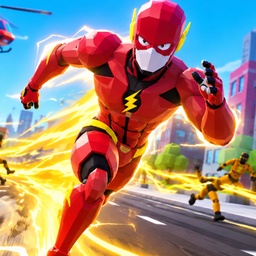
If there's one game that embodies how to play Flash with pure energy, it's this one. You're playing as a Flash-themed superhero with super speed as your core mechanic. The game wraps that mechanic around action gameplay that escalates quickly. Fast reflexes, faster everything. The kind of game where your first run teaches you the layout and your second run is where you actually start playing well.
Hero 2: Flash - Super Speed
Staring at the clock waiting for your shift to end or just need a lightning-fast distraction to clear your head? Hero 2: Flash - Super Speed is the ul...
▶ Play FreeCover Orange: Journey
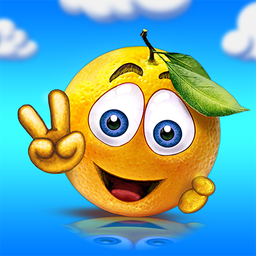
A physics puzzle classic. You're protecting oranges from incoming rain using objects and contraptions you place on screen. The challenge ramps up smartly, and the satisfaction of an elegant solution — using two objects to do what others need five — is exactly what Flash puzzle design does best. Each level can be solved multiple ways, which means there's genuine creativity in finding your approach.
Cover Orange: Journey
Stuck in a boring meeting or just need a mental refresh between tasks, a quick dose of physics-based fun is exactly what the doctor ordered. Cover Ora...
▶ Play FreeMonster Bash
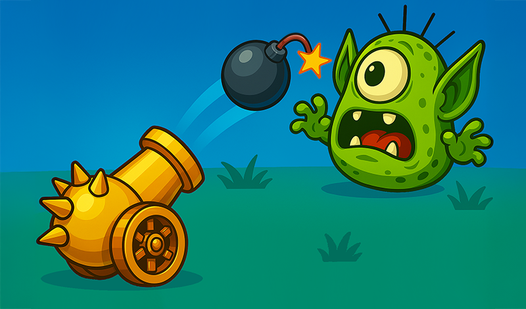
Monster Bash is the kind of game that proves you don't need a complex premise for a compelling experience. Simple mechanics, well-designed challenges, and the right amount of escalation. Perfect for a session where you want to play something in a flash — pick it up, put it down, come back to it. No friction, all fun.
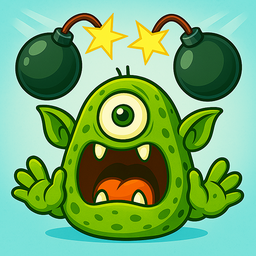
Monster Bash
Fans of physics-based destruction games will find their new obsession in Monster Bash. These rowdy rolypoly monsters are causing chaos across the scre...
▶ Play FreeSnail Bob 3: Mysterious Island
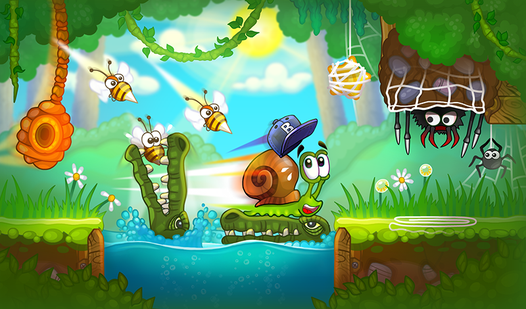
The Snail Bob series is legendary in Flash gaming circles. Bob moves automatically, and you interact with the environment to clear his path. It sounds simple — and the early levels are — but the puzzle complexity builds into something genuinely satisfying. Mysterious Island takes the formula to a new setting with new mechanics. If you haven't played this series, start here.
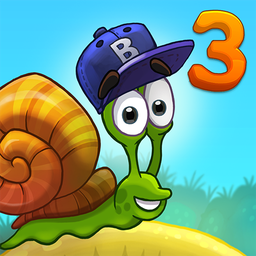
Snail Bob 3: Mysterious Island
Staring at the clock and waiting for your shift to end makes the afternoon drag on forever. Snail Bob 3: Mysterious Island is the perfect distraction ...
▶ Play FreeFlower Bubble: Merge & Match
Merge games have become their own genre, and Flower Bubble does the format well. Match and merge bubbles to create higher-tier flowers, managing the board before it fills up. The visual design is light and pleasant, the gameplay is meditative when you're in flow state, and the strategic depth is higher than the cute aesthetic suggests. Good for sessions where you want engagement without stress.

Flower Bubble: Merge & Match
Casual puzzle fans will find their new obsession in Flower Bubble: Merge & Match, a vibrant experience that turns simple sorting into a calming brain ...
▶ Play FreeRaid Heroes: Sword and Magic
For players who want something with more depth, Raid Heroes delivers RPG mechanics in a Flash-style package. Build your party, manage resources, and fight your way through increasingly tough encounters. The game rewards strategic thinking about team composition over raw reflex skill — a nice change of pace from pure action games.
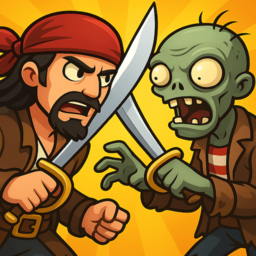
Raid Heroes: Sword and Magic
Staring at the clock waiting for your shift to end or just need a mental escape during a dull afternoon? Raid Heroes: Sword and Magic is the perfect d...
▶ Play FreeHow to Get Better at Flash Games: The Actual Honest Answer
Here's what most gaming guides won't tell you: improvement in Flash games is mostly about attention, not natural talent.
The players who beat hard levels aren't necessarily faster or smarter. They're paying closer attention to what's happening on screen. They notice the enemy pattern on attempt three. They spot the platform timing on attempt five. They adjust.
The mental model that helps most:
Every failed attempt is data. Not a failure. Not a reason to feel bad. Data about what the game is doing and what you need to do differently. Players who treat failure as information improve faster than players who treat it as punishment.
Second honest truth: Flash games have varying quality. Some are brilliantly designed. Some are frustrating because they're poorly balanced, not because you're playing wrong. If a game feels genuinely unfair — enemy damage too high, controls too slippery, RNG too punishing — that's sometimes a design problem. Move on. There are thousands of games. Your time matters.
Third honest truth: most Flash games are beatable with patience and attention. The mechanics are designed to be learnable. If you're stuck, take a break, come back, and pay attention to what specifically is killing you. That specificity usually points directly to the solution.
Community, Competition, and the Social Side of Flash Gaming
Flash gaming always had a community dimension. High score boards, speedrunning, challenge runs where players impose their own restrictions — the social layer adds replay value that single-player completion doesn't.
If you want to get more out of Flash gaming than solo play, look for:
- Score chasing: Many games have built-in leaderboards. Competing for top spots forces you to optimize every decision.
- Speedrunning: Completing games as fast as possible is its own skill set, and the Flash gaming community has active speedrun scenes for many classic titles.
- Minimal-resource runs: Complete the game using as few lives, moves, or resources as possible. Creates challenge in games you've already beaten.
- Watching others play: Seeing how skilled players approach games you're stuck on is often more educational than any written guide.
The social dimension transforms Flash gaming from a casual time-passer into something with genuine depth and community. Most players never explore this layer — and it's one of the most underrated parts of the genre.
A Note on Accessibility
One of the underappreciated strengths of Flash and Flash-style games is their accessibility. Low system requirements mean they run on almost any device. Browser-based means no installation. Free-to-play means no financial barrier. Simple controls mean players without gaming backgrounds can participate.
If you're helping someone discover gaming for the first time — a younger sibling, a parent, a friend who "doesn't play games" — Flash-style games are often the best entry point. The learning curve is shallow enough to be encouraging without being so easy that there's nothing to engage with.
Games like those in this list hit that balance: immediately understandable, satisfying from the first session, but with enough depth that you improve over time and notice the difference.